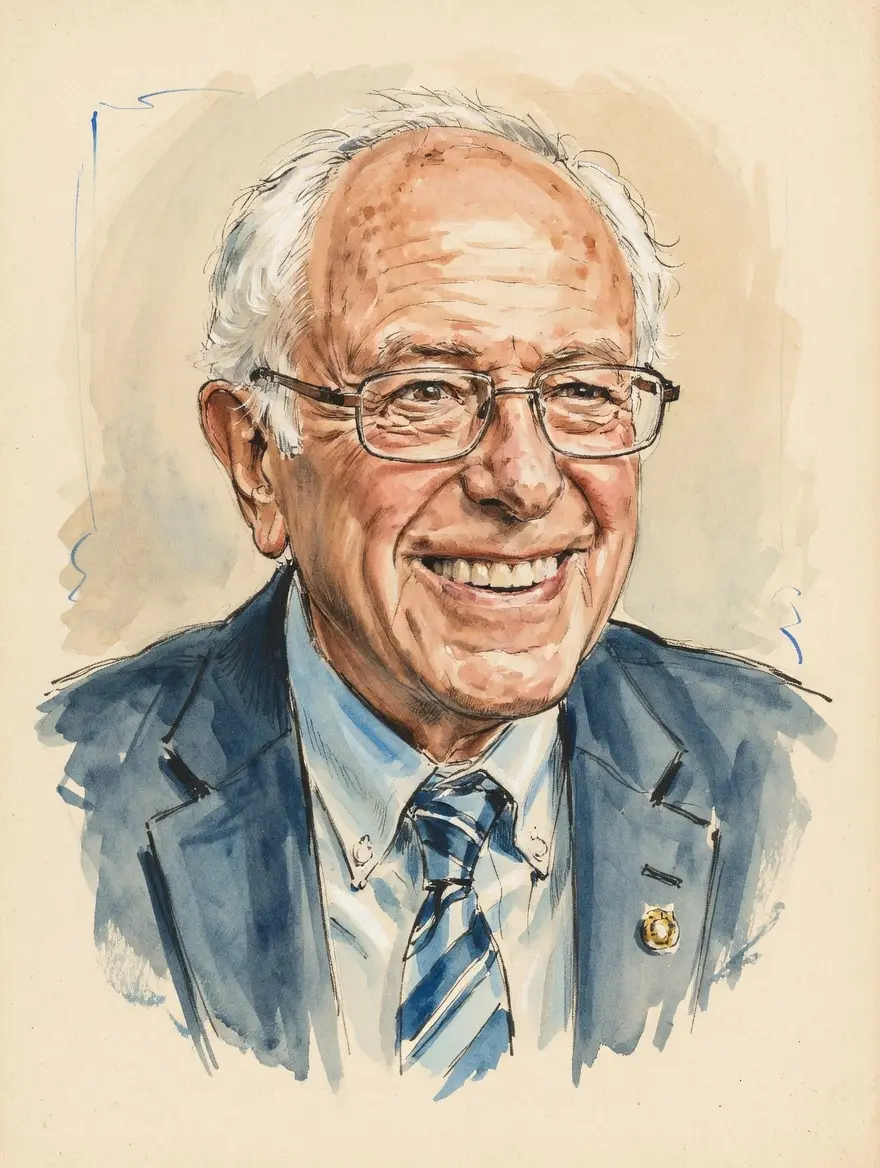
Bernie Sanders on Socialism
TL;DR
Bernie Sanders self-identifies as a democratic socialist, framing his vision around extensive social programs and economic fairness.
Key Points
He defines his democratic socialism by referencing Franklin D. Roosevelt's proposal for a Second Bill of Rights in 1944.
In his youth, he advocated for the nationalization of major industries like banking and energy while in the Liberty Union Party.
He supports workplace democracy, including legislation to aid workers in forming their own worker-owned cooperatives.
Summary
Bernie Sanders explicitly identifies as a democratic socialist, a term he sought to define and normalize within modern American politics, particularly during his presidential campaigns. He links his ideology to historical American progressivism, citing Franklin D. Roosevelt's call for a Second Bill of Rights as evidence that expansive social programs, like Social Security and the minimum wage, were once labeled socialist but are now American fabric. He argues that democratic socialism means creating an economy that serves everyone, not just the wealthiest one percent, and involves reforming what he views as a corrupt political system.
While holding this self-identity, Sanders's platform has drawn commentary regarding its alignment with traditional socialist definitions, with some critics suggesting his policies are better classified as social democracy, focusing on reforming capitalism rather than abolishing it entirely. His historical record shows advocacy for nationalization of major industries, though his contemporary focus is on large-scale government intervention, worker ownership via cooperatives, and establishing rights like healthcare and education. He consciously uses the label to reframe the concept in the US political landscape, where it was long demonized, viewing his electoral success as a way to advance the broader socialist tradition through incremental, democratic means.
Key Quotes
What we have seen is that while the average person is working longer hours for lower wages, we have seen a huge increase in income and wealth inequality, which is now reaching obscene levels. This is a rigged economy, which works for the rich and the powerful, and is not working for ordinary Americans ... You know, this country just does not belong to a handful of billionaires.
We work somebody to the point of no return, and we get rid of them and get somebody else in. It's not a culture where people are respected, are nourished.
Frequently Asked Questions
Bernie Sanders defines democratic socialism as creating a just society that guarantees economic rights, such as healthcare and education, for all citizens. He bases this vision on historical American progressivism, drawing inspiration from Franklin D. Roosevelt's policies. Sanders emphasizes this is distinct from authoritarian state socialism.
Sanders was more openly radical and self-described as a socialist when he first entered politics in the 1970s and 1980s. His political positions have since shifted toward a more pragmatic focus on social democracy while still maintaining the core label of 'democratic socialist' on the national stage.
Many academics and commentators argue that Sanders's platform is more accurately characterized as social democracy because it seeks to reform, rather than abolish, capitalism. However, some on the left view his work as instrumental in advancing socialist ideas in mainstream US politics.
Sources6
Socialism is not a dirty word: Bernie Sanders really is changing US democracy
Bernie Sanders Defines Democratic Socialism in Georgetown Speech
How Socialist Is Bernie Sanders? | Hoover Institution
Political positions of Bernie Sanders - Wikipedia
What Bernie Sees in the New Deal - Jacobin
Was Bernie Sanders ever an actual socialist? : r/Socialism_101
* This is not an exhaustive list of sources.