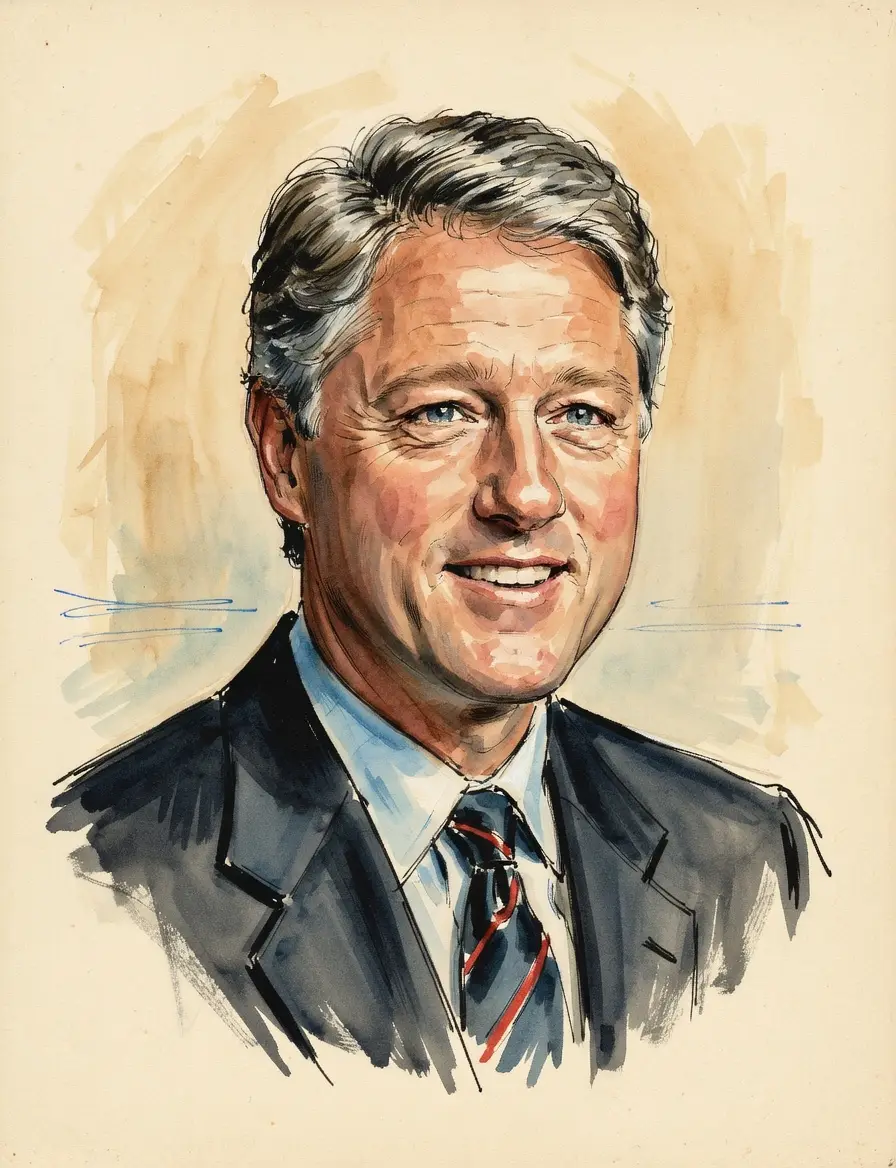
Bill Clinton on Foreign Policy
TL;DR
Bill Clinton championed an activist foreign policy centered on 'democratic enlargement' through free trade, alliances, and principled intervention where feasible.
Key Points
He advocated for the 'doctrine of enlargement,' seeking to expand the community of market democracies worldwide.
The administration facilitated the Dayton Peace Accords in 1995, ending the war in Bosnia through NATO bombing and diplomacy.
His administration successfully persuaded Russia to withdraw its troops from the Baltic Republics of Estonia and Latvia by 1994.
Summary
Bill Clinton entered office with limited foreign policy experience, facing a post-Cold War world demanding a new approach. His administration developed and pursued the "doctrine of enlargement," which was founded on expanding market democracies globally. This doctrine embraced free trade, multilateral peacekeeping, international alliances, and a commitment to intervene in world crises that were both morally justifiable and practical with low risk to American lives. He believed the U.S. held a solemn responsibility to lead in promoting human dignity and democracy internationally, but cautioned against acting in isolation or overextending national resources. Early in his term, the administration faced challenges and hesitations in Somalia, Rwanda, and Haiti, which led to criticism regarding his preparedness as a statesman.
Despite initial difficulties, the administration secured notable foreign policy accomplishments, including persuading Russia to withdraw troops from the Baltic Republics and pushing through major trade agreements like NAFTA and GATT revisions. Major challenges were managed in the Balkans, where force and diplomacy ended the fighting in Bosnia via the Dayton Peace Accords, and later through NATO bombing to stop ethnic cleansing in Kosovo. Dealing with former adversaries also saw success in persuading Russia to reduce its nuclear arsenal, though the overall policy evolved from initial incoherence to a more proactive, focused stance by the second term, often driven by the need to protect domestic political standing.
Frequently Asked Questions
Bill Clinton's core foreign policy concept was the 'doctrine of enlargement,' which focused on expanding the community of market democracies globally. This meant actively promoting free trade, supporting international alliances, and intervening in global crises when deemed practical and morally necessary.
Yes, the former president faced significant challenges early in his term, particularly concerning troop deployments. Initial military efforts in Somalia grew into a struggle that led to a withdrawal, and both the U.S. and the UN were criticized for not acting aggressively enough to stop the genocide in Rwanda.
Notable successes included brokering peace negotiations in Northern Ireland, which resulted in the Good Friday Agreement, and achieving breakthroughs in Middle East peace talks between Israeli and Palestinian leaders. He also oversaw the successful enlargement of NATO to include Poland, Hungary, and the Czech Republic.
Sources9
Clinton reflects on foreign policy triumphs and challenges — Harvard Gazette
President Bill Clinton Shares Insights on Foreign Policy and Diplomacy | The Belfer Center for Science and International Affairs
President Bill Clinton on U.S. Foreign Policy | On the Record
Martin S. Indyk Memorial Lecture: A Conversation With President Bill Clinton | Council on Foreign Relations
Bill Clinton: Foreign Affairs | Miller Center
Clinton's Foreign Policy in Somalia, Bosnia, Haiti, and North Korea | Hoover Institution
Remarks on United States Foreign Policy in San Francisco | The American Presidency Project
Foreign Policy Rhetoric in the 1992 Presidential Campaign: Bill Clinton's Exceptionalist Jeremiad
“Foreign Policy Is Not What I Came Here to Do” Dissecting Clinton's Foreign Policy-Making: A First Cut
* This is not an exhaustive list of sources.