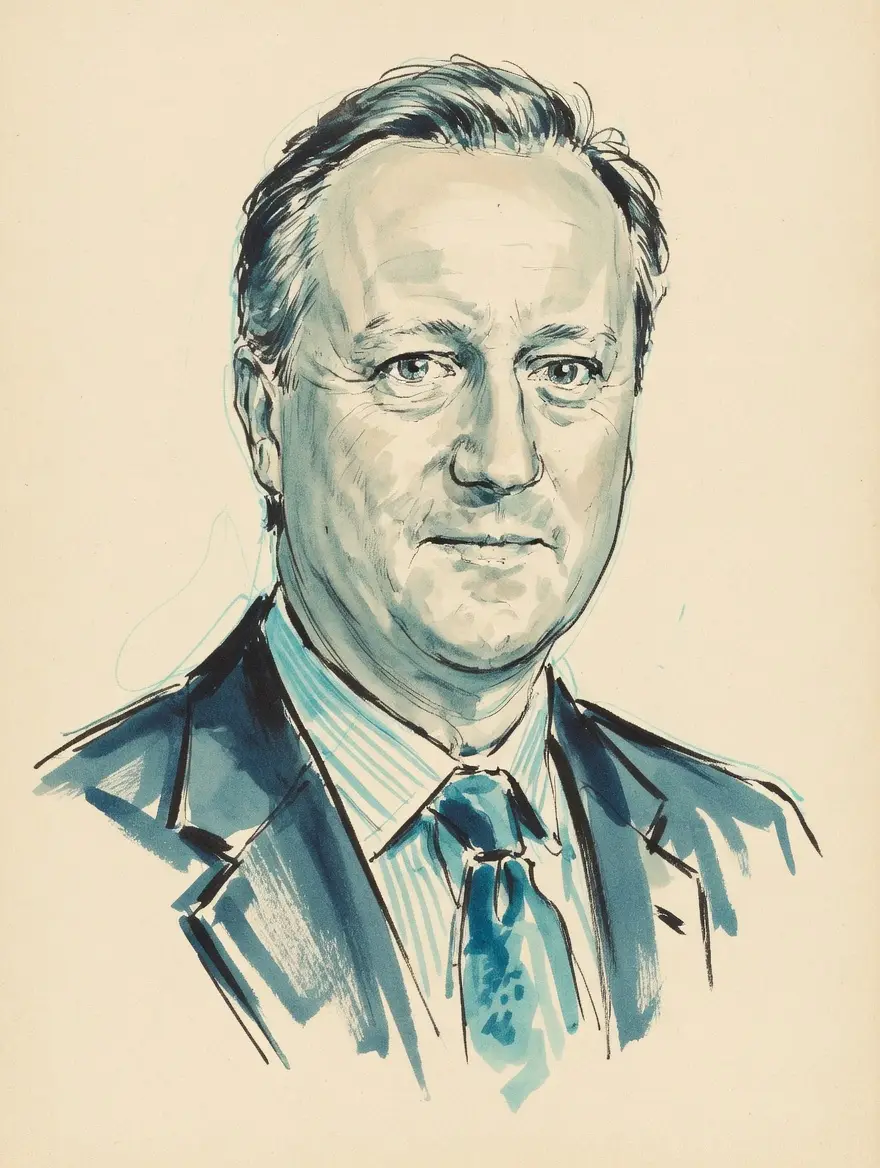
David Cameron on Coalition Government
TL;DR
David Cameron led the UK's first coalition government since 1945, formed after the 2010 general election resulted in a hung parliament.
Key Points
He became Prime Minister on May 11, 2010, leading the first coalition since 1945.
The administration featured a core decision-making group known as the "Quad" composed of four senior ministers.
The government successfully reduced the budget deficit through a programme of public spending restraint.
Summary
David Cameron formed the Cameron–Clegg coalition government on May 11, 2010, after the general election resulted in a hung parliament, leaving his Conservative Party short of an overall majority. This administration was the first full coalition government in the United Kingdom since 1945, pairing Cameron's centre-right Conservatives with the centrist Liberal Democrats led by his Deputy Prime Minister, Nick Clegg. The core decision-making body was known as the "Quad," consisting of Cameron, Clegg, the Chancellor of the Exchequer, and the Chief Secretary to the Treasury, tasked with resolving major policy disputes and overseeing the coalition's operation. The two parties shared collective responsibility for government positions, though the Coalition Agreement also detailed specific issues where they agreed to differ, with the Liberal Democrats sometimes abstaining from votes.
The coalition undertook significant policy measures, including a programme of public spending restraint to reduce the budget deficit following the global financial crisis, and established the Fixed-term Parliaments Act 2011. Within the governing arrangement, tensions occasionally surfaced, notably when Liberal Democrat MPs joined Labour to defeat the government’s timetable motion for the proposed reform of the House of Lords in 2012, leading the Deputy Prime Minister to withdraw support for a related Conservative measure. The government governed for five years, concluding after the 2015 general election, where Cameron subsequently led the Conservatives to form a majority government.
Frequently Asked Questions
David Cameron served as the Prime Minister throughout the duration of the Cameron-Clegg Coalition Government, which ran from 2010 to 2015. He led the centre-right Conservative Party in this unprecedented post-war partnership with the Liberal Democrats. His position was to provide the overall leadership and stability necessary for the country following a hung parliament.
The Coalition Government ended following the 2015 general election, which returned a Conservative majority government. David Cameron subsequently formed his second, single-party ministry. The coalition itself had operated for five years, starting in May 2010.
Disputes between the Conservative and Liberal Democrat parties within the coalition were typically resolved by a small core group referred to as the "Quad." This group comprised the Prime Minister, Deputy Prime Minister, the Chancellor, and the Chief Secretary to the Treasury. This mechanism ensured major policy matters were agreed upon between the two parties.
Sources5
Cameron–Clegg coalition - Wikipedia
David Cameron - Coalition, Politics, UK | Britannica
History of The Rt Hon Lord Cameron - GOV.UK
David Cameron and Nick Clegg lead coalition into power | Conservatives | The Guardian
The 2010 Coalition Government at Westminster - House of Commons Library
* This is not an exhaustive list of sources.