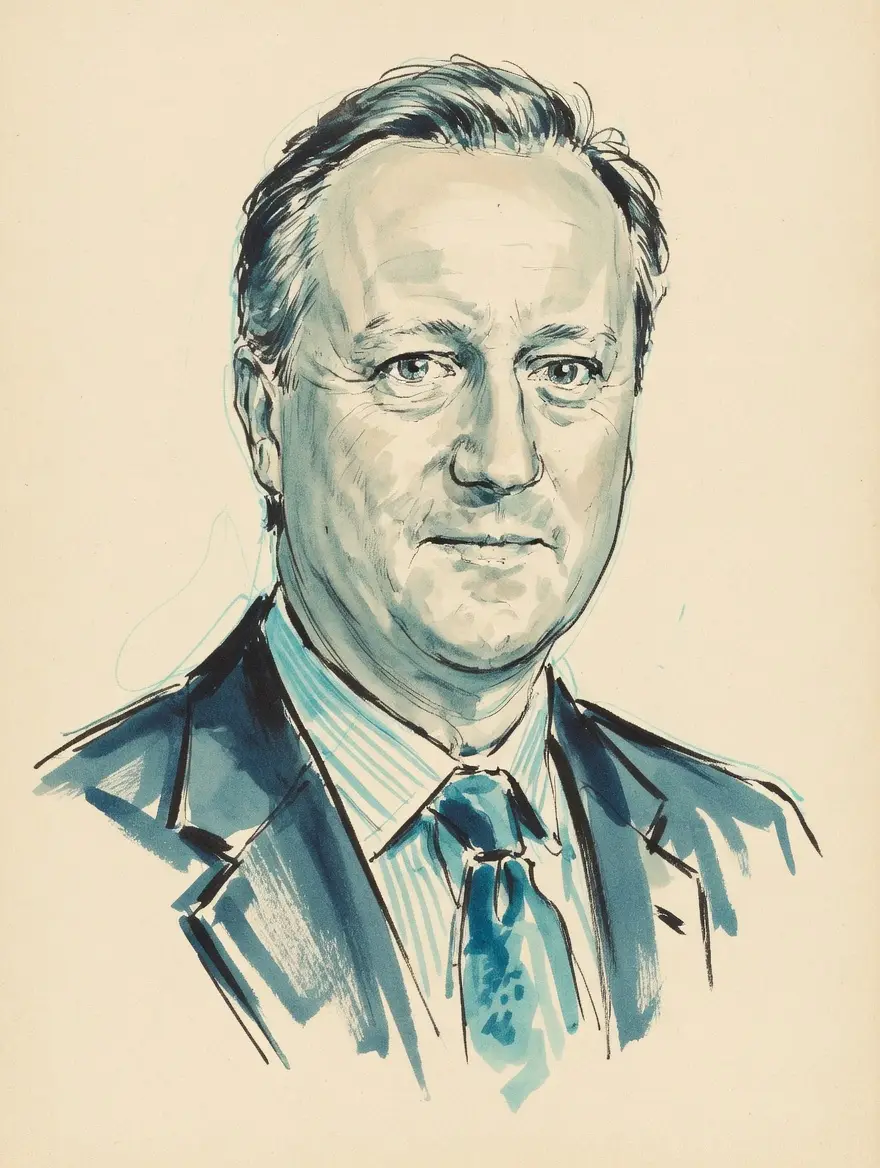
David Cameron on Economic Policy
TL;DR
David Cameron's economic policy focused on deficit reduction through austerity, while advocating for social responsibility and some tax restructuring.
Key Points
His coalition government's first priority upon taking office in May 2010 was to 'reduce the deficit and restore economic growth'.
His government implemented a programme of austerity, characterized by deep cuts to non-capital public spending outside of the NHS and education day-to-day budgets.
He supported restructuring the tax system, including raising VAT from 17.5% to 20% while cutting the main rate of corporation tax from 28% to 19% by 2018.
Summary
David Cameron, as Prime Minister, fundamentally prioritized reducing the national budget deficit, a stance that became known as austerity. This policy, adopted following the 2008 financial crisis, involved a sustained, large-scale reduction in public spending, with the initial aim to achieve fiscal tightening achieved mainly through cuts rather than tax rises. While key areas like the NHS, schools, and foreign aid day-to-day budgets were nominally ring-fenced, non-ring-fenced departments, local authorities, and working-age welfare programs experienced significant real-terms cuts. Concurrently, his government pursued tax policy changes that included raising VAT while cutting the main rate of corporation tax and increasing the income tax personal allowance in real terms, though overall taxes eventually rose during his premiership.
His broader economic philosophy involved seeking a middle path, describing himself as a 'modern compassionate conservative' and expressing a desire to focus on 'general well-being' (GWB) over just GDP. However, the implementation of austerity has been critically linked to poor economic growth and stagnant real wages throughout the 2010s, with the 2016 Brexit referendum further exacerbating economic uncertainty and negatively affecting business investment. Furthermore, his government's protection of pensioner benefits while cutting working-age support exacerbated distributional consequences, particularly regarding asset-wealthy older generations versus younger wage-dependent individuals.
Key Quotes
It's time we admitted that there's more to life than money, and it's time we focused not just on GDP, but on GWB – general well-being
Frequently Asked Questions
David Cameron's primary economic focus upon entering office in 2010 was the reduction of the government's budget deficit. This led to the implementation of a broad austerity program involving significant cuts to public spending.
No, economic analysis indicates that real wages were virtually stagnant throughout much of David Cameron's time in office. This lack of wage growth, despite employment booming, has been highlighted as a major issue.
The Cameron government's austerity plan involved cuts to working-age benefits, which were made less generous, contrasting with the protection offered to state pensions. This approach has been criticized for exacerbating inequality.
Sources8
The Economics of Brexit: What Cameron Got Wrong
Economic policy + David Cameron | Page 50 of 56 | The Guardian
David Cameron is a symbol of a broken economic model
Political positions of David Cameron - Wikipedia
The Conservatives and the Economy, 2010–24 | Institute for Fiscal Studies
Unfortunately, David Cameron Is Back in British Government - Jacobin
'Sharing the Proceeds of Growth': Conservative Economic Policy under David Cameron
* This is not an exhaustive list of sources.