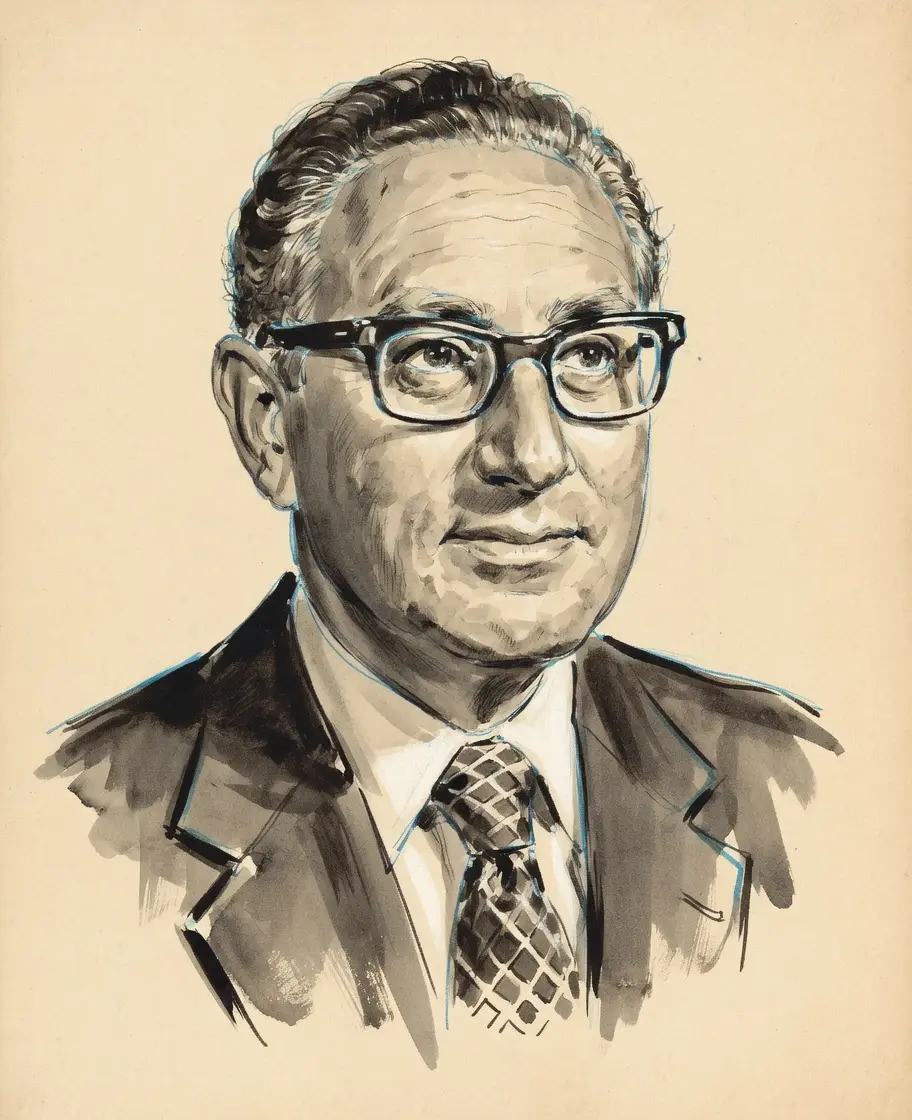
Henry Kissinger on Diplomacy
TL;DR
Henry Kissinger views diplomacy as the essential art of statesmanship rooted in the balance of power and national interest.
Key Points
His major work, Diplomacy, spans history from the 17th century to the post-Cold War period, focusing on the evolution of statecraft.
He cautions against an American tendency to rely on utopian ideals, arguing for a return to the European-style realpolitik and balance-of-power concepts for national survival.
He pioneered the concept of "shuttle diplomacy" but advised against its use unless a basic accord among all interested parties had already been established.
Summary
Henry Kissinger posits that successful diplomacy is fundamentally built upon the European concept of the balance of power, which prioritizes stability and moderation over perpetual peace or utopian ideals. His seminal work on the subject illuminates a historical trajectory from Cardinal Richelieu's introduction of the nation-state, through the dominance of the balance of power, to the American insistence on idealism and collective security. He argues that while the American approach—driven by moral convictions and a desire to crusade for democracy—clashes with traditional European power politics, history shows that states prosper when statesmen reconcile national interests with geopolitical necessity.
He further contends that the post-Cold War era requires the United States to adapt, noting that its historic hegemony is declining and that the emerging world order will be more fragmented, resembling earlier multistate systems. Kissinger demonstrates how American thinking, shielded by geography and idealism, often misunderstood the 'school of hard knocks' diplomacy forged in Europe. His analysis suggests that for America to maintain its position, it must temper its Wilsonian idealism with a realist appraisal of power dynamics, even as the global landscape evolves into one with multiple major powers.
Key Quotes
My overwhelming concern was not to meet Mao on the first trip, because security advisers survive with the good will of the president, and I knew that Nixon had his heart set on being the first person to meet Mao. … I contrived everything I could never to be even close to asking to meet Mao because I knew my life in Washington.”
Frequently Asked Questions
Henry Kissinger strongly believed that the art of diplomacy is fundamentally structured around the concept of the balance of power, a principle forged in Europe. He viewed it as the most effective historical mechanism for achieving stability and limiting conflict among great powers. His position centers on national interest as the ultimate purpose, contrasting with purely idealistic or moralistic foreign policy approaches.
Kissinger characterized the American approach as torn between acting as a 'beacon' of democracy at home and a 'crusader' abroad. He believed this idealism often conflicted with the pragmatic necessities of international relations. He argued America must reconcile these values with geopolitical realities to navigate the emerging world order successfully.
The most stable international systems, in his view, were the one established at the Congress of Vienna (1815) and the post-World War II order dominated by the U.S., both characterized by a relatively uniform perception among major actors. He highly values the period dominated by the balance of power among European states.
Sources7
Diplomacy | Book by Henry Kissinger | Official Publisher Page | Simon & Schuster
download-kissingers-diplomacy.pdf - euroclassworks
Is H. Kissingers "Diplomacy" a must-read? What should I consider? : r/IRstudies
Diplomacy - Henry Kissinger - Google Books
Kissinger, on diplomacy — Harvard Gazette
Diplomacy by Henry Kissinger | Goodreads
Diplomacy (Kissinger book) - Wikipedia
* This is not an exhaustive list of sources.