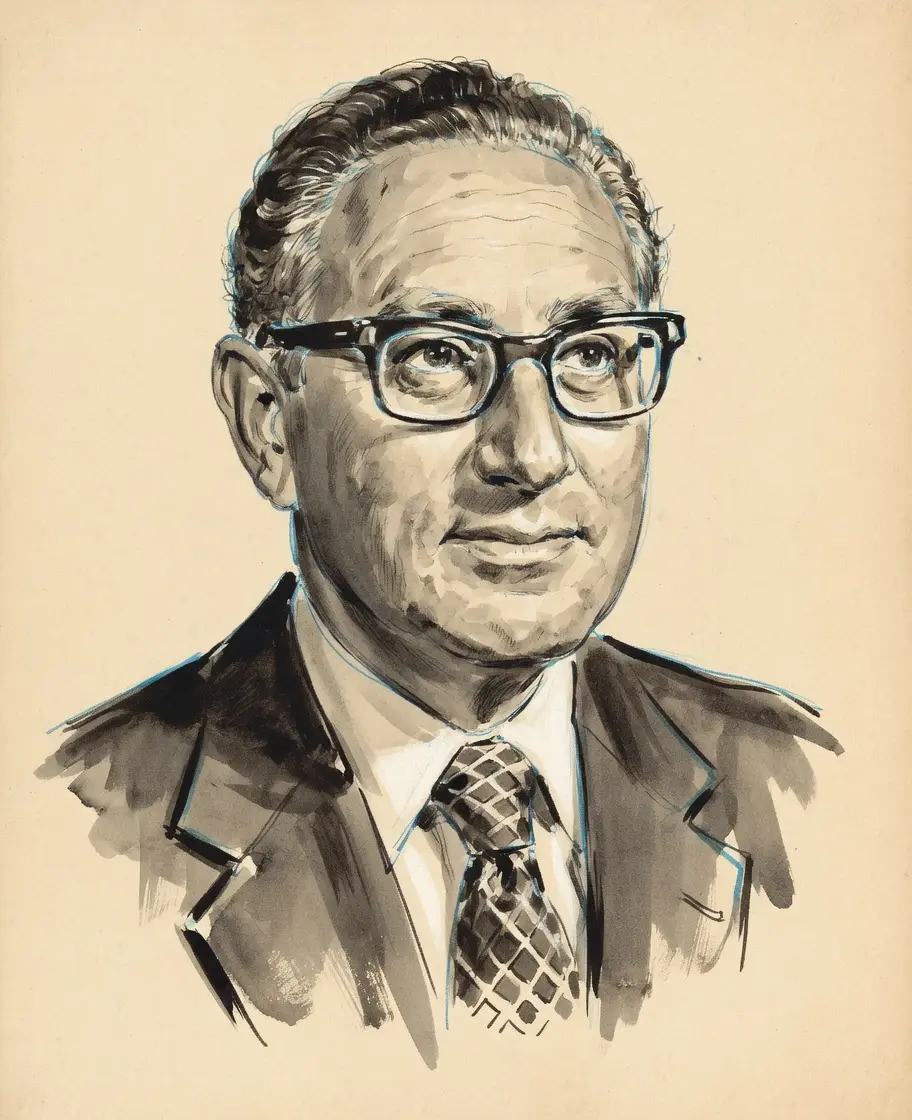
Henry Kissinger on Foreign Policy
TL;DR
Henry Kissinger advocated for a foreign policy rooted in the pragmatic maintenance of a global balance of power, tempered by historical context.
Key Points
He was responsible for negotiating the first Strategic Arms Limitation Treaty (SALT I) and opening diplomatic communications with the People's Republic of China between 1969 and 1975.
He argued that the greatest need of the contemporary international system is an agreed concept of order, as military bipolarity has yielded to political multipolarity.
In his early writing, he defined 'legitimacy' not as justice, but as an international agreement on the nature of workable arrangements and permissible foreign policy aims.
Summary
Henry Kissinger’s foreign policy stance centered on a realistic assessment of international relations, emphasizing the maintenance of a global balance of power, a concept he derived from his study of 19th-century European statesmanship. He rejected pure Wilsonian idealism, which he believed led to policy paralysis due to its insistence on universal morality over practical necessity. However, he also warned against pure realpolitik, as it could become unprincipled and make power an end unto itself, contrasting with his preference for tempering power with visionary statesmanship. For him, a stable international order required understanding the historical context of rivals and allies, recognizing that policy decisions often involve choices between evils, and using power rationally to achieve manageable objectives rather than abstract ideals.
The implication of his framework is that foreign policy must evolve as the structure of the international system changes; for instance, he sought to manage the bipolar world of the Cold War through détente and strategic alignments, such as the opening to China, which was intended to exploit Sino-Soviet antagonism and stabilize relations. In a world of increasing political multipolarity, the necessity remains for an agreed concept of order backed by power, demanding a contribution from the United States that evokes willing cooperation rather than imposing a design.
Key Quotes
“The insistence on pure morality is in itself the most immoral of postures,”
Frequently Asked Questions
Henry Kissinger was a proponent of Realpolitik, believing that foreign policy must be grounded in a cool assessment of national self-interest and the maintenance of a balance of power among major states. He sought to temper this realism with visionary statesmanship, acknowledging the need for moral principles while prioritizing stability. His approach required policymakers to act based on imperfect knowledge and choose the lesser of evils when necessary.
He rejected the pure idealism associated with Woodrow Wilson, arguing that an insistence on absolute morality could lead to disastrous inaction in international affairs. However, he did not advocate for a morally vacuous realism; his later thought suggested that genuine peace requires transcendent ideals alongside tactical pragmatism. For him, ideals needed restraint derived from an understanding of power dynamics.
During the Cold War, Kissinger pioneered détente with the Soviet Union to manage tensions while simultaneously exploiting the Sino-Soviet antagonism by opening relations with China. He believed the age of military bipolarity was ending and that political multipolarity required a new concept of order. His primary goal was to manage the inevitable competition between great powers.
Sources6
Kissinger's Lessons for American Foreign Policy Today
Henry Kissinger and the Study of Global Affairs
Henry Kissinger, Foreign Policy, and Global Health
Henry Kissinger and the American Century
Foreign Relations of the United States, 1969–1976, Volume I, Foundations of Foreign Policy, 1969–1972 Document 4
Henry Kissinger - Wikipedia
* This is not an exhaustive list of sources.