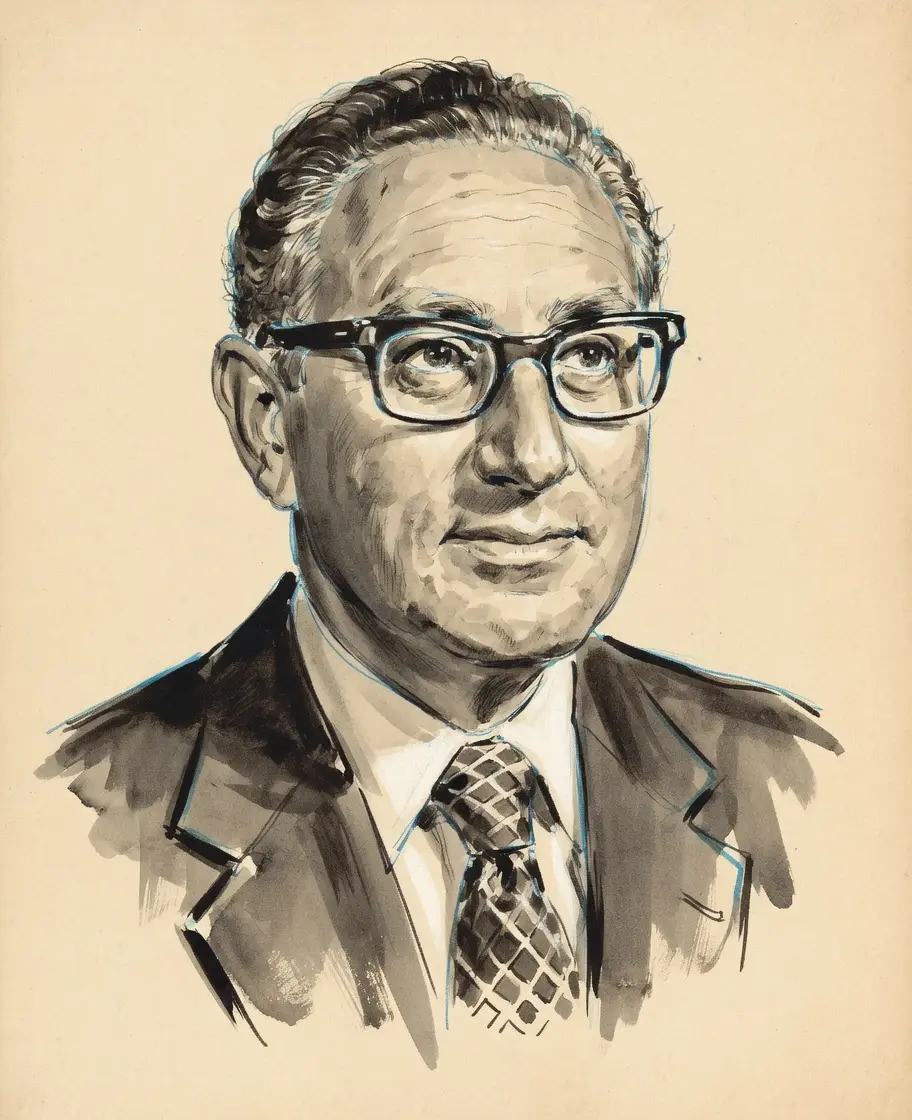
Henry Kissinger on Taiwan
TL;DR
Henry Kissinger's position prioritizes stable U.S.-China relations by accepting the 'one China' premise while advocating for a peaceful, non-provocative cross-strait resolution.
Key Points
He agreed to language in the 1972 Shanghai Communiqué stating the U.S. does not challenge the position that Taiwan is part of China.
Kissinger explicitly pledged to the PRC in 1972 that the U.S. would oppose any offensive military action from Taiwan against the mainland.
Toward the end of his life, he stated that a military conflict between China and Taiwan was probable on the current trajectory of relations.
Summary
Henry Kissinger, as the architect of the 1972 opening to the People's Republic of China (PRC), fundamentally shifted U.S. policy away from Taiwan, leading to Washington's derecognition of Taipei. His core historical position, as enshrined in the Shanghai Communiqué, was that the United States acknowledged that all Chinese on either side of the strait maintain there is but one China and Taiwan is part of China. He explicitly pledged to oppose any offensive military action from Taiwan against the mainland and assured Beijing that American personnel would not encourage the Taiwan Independence Movement. This foundational shift was driven by strategic priorities regarding the Soviet Union, with Kissinger viewing Taiwan as less central than achieving rapprochement with Beijing.
In later years, Kissinger expressed concern about the current trajectory leading to conflict, suggesting the framework he established must be altered. He maintained that the delicate path involves not challenging the principle of 'one China' while simultaneously making clear the U.S. has an intense interest in a peaceful resolution, which implies resisting a PRC attack but discouraging Taiwanese moves toward formal separation. He strongly believed that if Taiwan proclaimed independence, it would be viewed by the PRC as a declaration of war, and that the U.S. commitment is to resist an unprovoked attack, not to support a declaration of sovereignty. This evolution reflects a persistent focus on maintaining the delicate status quo through strategic restraint from both sides.
Key Quotes
Most famously, at the Asia Society in New York in 2007, he said that Taiwan should start working on a political solution with its giant neighbor because “China will not wait forever.”
Frequently Asked Questions
Henry Kissinger’s core view, established during the normalization of U.S.-China relations, is that the United States must acknowledge the 'one China' premise. He believed that maintaining the delicate balance requires avoiding any explicit challenge to the principle that Taiwan is part of China, while simultaneously securing a peaceful resolution to the differences.
No, Henry Kissinger did not support Taiwanese independence. He explicitly stated that the U.S. would not give encouragement or support to the Taiwan Independence Movement. He warned that if Taiwan were to declare itself a sovereign separate state, it would likely trigger a major crisis with the People's Republic of China.
While the fundamental linkage to the 'one China' policy remains, Henry Kissinger's later commentary showed increasing concern over the possibility of conflict. He recognized the framework he created was becoming 'archaic' relative to Taiwan's political reality, stressing that the current trajectory needed alteration to avoid war.
Sources5
Interviews - Henry Kissinger | Dangerous Straits | FRONTLINE
Kissinger had a profound impact on Taiwan
No Support for Taiwan Independence, Nixon Assured China in 1972; New Documents Reveal Origins of Current U.S. Policy
America’s Sellout of Taiwan and Embrace of Red China Was a Failure on its Own Terms
Kissinger had a profound impact on Taiwan : r/taiwan
* This is not an exhaustive list of sources.