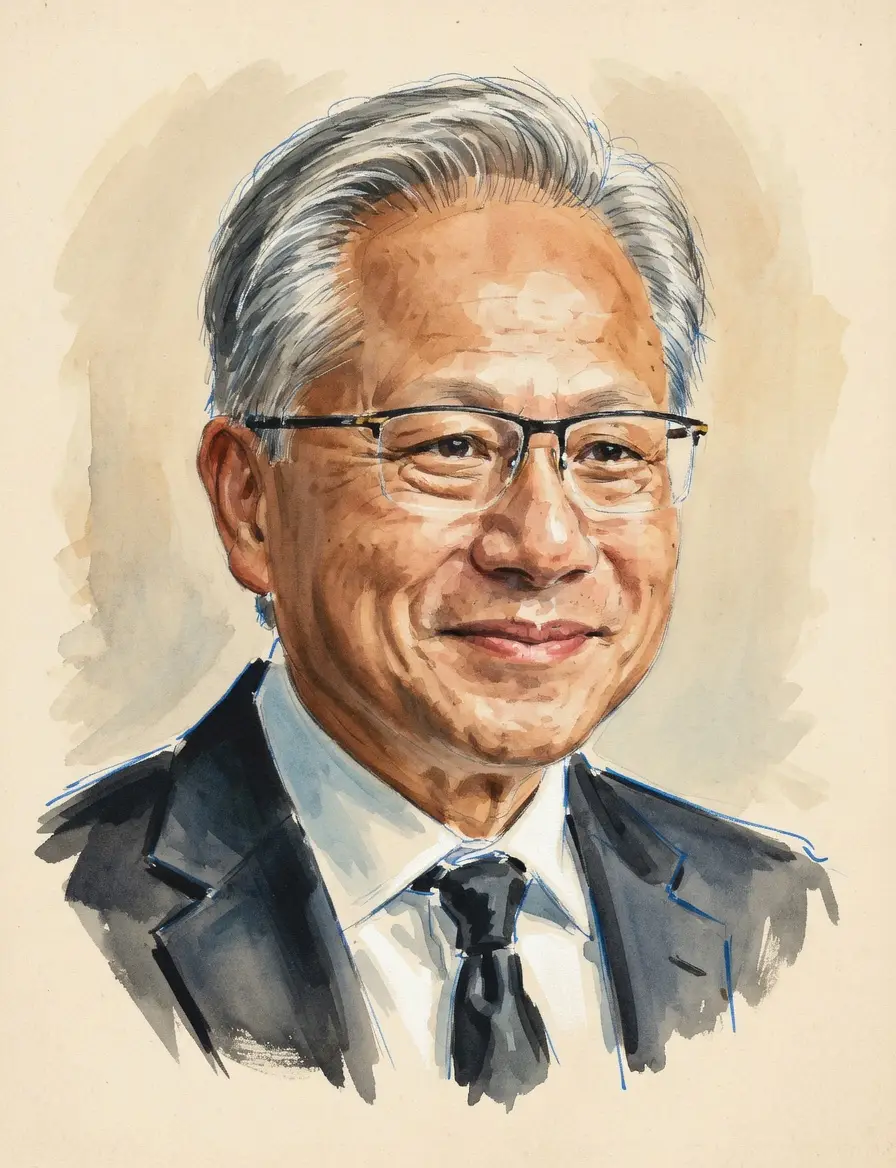
Jensen Huang on Elon Musk
TL;DR
Jensen Huang respects Elon Musk's vision and early support but views his ambitious manufacturing plans as extremely difficult to execute.
Key Points
Huang commended Elon Musk for being the first customer for the DGX-1 AI supercomputer in 2016.
He acknowledged assisting Musk with building the initial computer systems for the Model S autonomous vehicle system.
Jensen Huang expressed that building advanced semiconductor fabrication plants is "extremely hard," pushing back on Musk's stated plans to build one.
Summary
Jensen Huang, CEO of NVIDIA, holds a mixed but generally respectful view of Elon Musk, acknowledging his visionary ambition while tempering expectations regarding technological execution, particularly in manufacturing. Huang highlighted that Musk was his very first customer for the DGX-1 AI supercomputer in 2016, having ordered one for his AI company when no one else would, demonstrating Musk's early belief in the technology. Furthermore, he commended Musk for believing in Tesla when the company had no purchase orders for the company's early hardware, including systems for autonomous driving.
However, Huang has also pushed back on Musk's more audacious proposals, such as building a chip fabrication plant to compete with leading manufacturers. The NVIDIA CEO stated that the complexity involved in what companies like TSMC achieve is "extremely hard," suggesting that Musk's belief in easily replicating that level of technology is an oversimplification of the challenges. While respecting the entrepreneurial spirit and collaboration on Tesla's vehicle computers, Huang places technological reality above hype when assessing the feasibility of Musk's manufacturing blueprints.
Frequently Asked Questions
Jensen Huang generally respects Elon Musk's vision and early belief in NVIDIA's technology, citing Musk as his first DGX-1 customer. However, he exhibits caution regarding the feasibility of some of Musk's massive manufacturing undertakings, such as building a chip fab. Huang notes the extreme difficulty in replicating world-class semiconductor manufacturing processes.
Yes, the two have collaborated, particularly on the computer systems used in Tesla vehicles for self-driving technology. Huang delivered the first DGX-1 supercomputer to Musk for his AI endeavors in 2016. This partnership shows a professional working relationship alongside their public commentary.
The NVIDIA CEO acknowledged that Elon Musk's concept of putting GPUs in space is not inherently 'crazy' or impossible. However, Huang pointed out that three significant barriers would need to be overcome for such a project to become a reality. This indicates a technical endorsement tempered by practical engineering constraints.
Sources4
NVIDIA CEO Jensen Huang commends Tesla's Elon Musk for early belief
Jensen Huang Says Elon Musk's GPUs-in-Space Idea Isn't Crazy—But 3 Huge Barriers Remain
NVIDIA CEO Jensen Huang Pushes Back on Elon Musk's 'Bold Plans' to Build a Chip Fab, Saying What TSMC Does Is “Extremely Hard”
Jensen Huang Calls Elon Musk the 'Ultimate GPU'
* This is not an exhaustive list of sources.