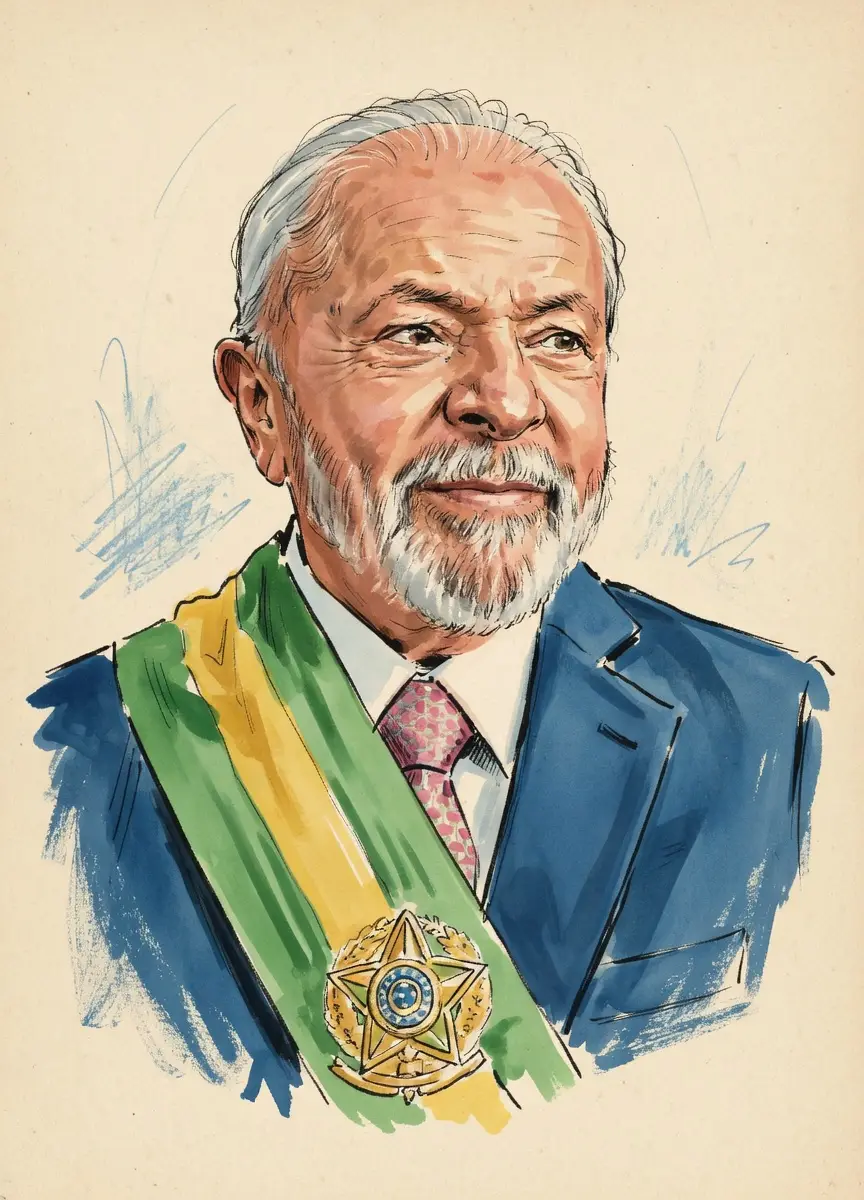
Lula da Silva on Political Ideology
TL;DR
Lula da Silva embodies Lulism, a pragmatic center-left ideology blending social liberalism with market economics to reduce poverty.
Key Points
He cofounded the Partido dos Trabalhadores (PT) in 1980, initially adhering to a radical posture advocating for socialist reform and workers' rights.
His first presidential term (2003–2010) saw him moderate his economic platform, implementing the bolsa família program and maintaining fiscal conservatism.
Lulism is characterized as a social liberal approach that unites organized labor with segments of the private industry by focusing on poverty reduction without touching core structural issues.
Summary
Luiz Inácio Lula da Silva is best defined by the political ideology coined as Lulism, which represents a consolidation of support for his leadership through controlled reformism aimed at society's poorest sections. This ideology, stemming from his Workers' Party roots, ultimately adopted a center-left political position while aiming for gradual socioeconomic change within a market-oriented framework, signaling a departure from earlier radical socialist rhetoric. Core to Lulism is the maintenance of economic stability and a state distributist approach, often described as a conservative variant of modernization that avoids drastic structural conflict with established financial elites.
His initial political stance, rooted in his history as a radical labor leader calling for socialist reform, moderated significantly upon achieving the presidency. This evolution involved a class-conciliatory attitude, where he promised respect for existing contracts and the global financial order to secure victory and govern effectively. While this pragmatic shift allowed for the implementation of massive social programs like bolsa família that significantly reduced poverty, it also led to criticism from the far-left for not sufficiently challenging entrenched economic structures or monopolies.
Frequently Asked Questions
Lula da Silva’s political ideology is primarily characterized as Lulism, which is positioned on the center-left. It is a pragmatic blend that combines social liberalism and the implementation of distributive social policies with a commitment to maintaining macroeconomic stability within a market framework.
Yes, his stance has noticeably evolved from his early career. He began as a founding member of the Workers' Party advocating for radical socialist positions, including the nationalization of key assets. Upon entering the presidency, he adopted a much more conciliatory and moderate line to ensure economic stability.
Lula da Silva is often described as occupying a space between social democracy and social liberalism, though his roots are in socialism. His governing praxis, Lulism, aims for a gradual reduction of the gap between rich and poor through market-oriented means rather than outright socialist structural change.
Sources4
Lulism - Wikipedia
Worker, prisoner, president: what the Left can learn from Lula's rise from humble childhood to becoming one of the world's most popular politicians
Lula in Historical and Political Context – Spectre Journal
Lula: The End of Latin American Populism?
* This is not an exhaustive list of sources.