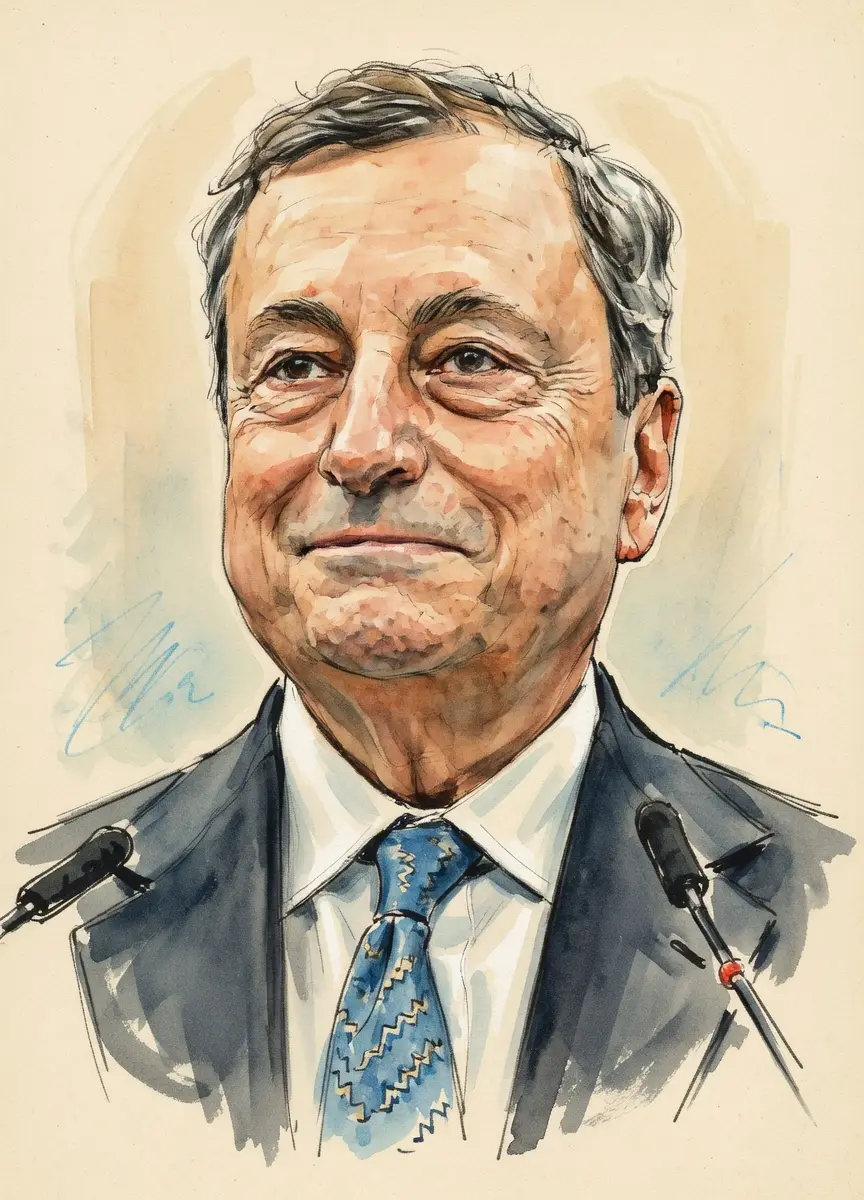
Mario Draghi on ECB Mandate
TL;DR
Mario Draghi firmly interpreted the ECB mandate as an obligation to use all necessary tools to ensure price stability.
Key Points
His commitment to price stability was defined as a symmetric inflation aim of below, but close to, 2% over the medium term.
He asserted that the announcement of Outright Monetary Transactions (OMT) in 2012 was an inescapable, mandate-preserving action against unwarranted redenomination risks.
Draghi advocated for further institutional reform of the euro area, noting that central bank independence functions within the context of interdependence with fiscal policy.
Summary
Mario Draghi's core position on the ECB mandate, as articulated during his presidency, centered on his commitment to deliver price stability, defined as an inflation rate below, but close to, 2% over the medium term. This was demonstrated most dramatically by his July 2012 pledge to do “whatever it takes” to preserve the euro, an action he later confirmed was within the bounds of the Treaty and necessary to fulfill the mandate, especially when facing the risk of a catastrophic unravelling of the euro area. He consistently argued that his use of unconventional tools, such as Outright Monetary Transactions (OMT) and asset purchases, was a flexible but strictly legal means to achieve the primary objective when conventional tools were exhausted, emphasizing his obligation to act when failure to do so would betray the mandate.
This stance involved accepting a broad discretion in tool deployment, which was subsequently affirmed by the European Court of Justice, validating his view of “independence in interdependence.” Draghi repeatedly stressed that while the ECB pursued its price stability mandate, achieving it could be faster and with fewer side effects if aligned with supportive fiscal policies from national governments. Critics, particularly from Germany, often alleged he exceeded the mandate, especially concerning bond purchases, yet he maintained that the policy approach, informed by rigorous analysis and courage, remained strictly within the confines of the law while addressing unforeseen challenges like deflationary risks.
Frequently Asked Questions
Mario Draghi viewed the ECB mandate, primarily price stability, as an absolute obligation requiring him to employ all available tools to secure it. He was prepared to act decisively, stating he would do “whatever it takes” to preserve the euro, considering this a necessary fulfillment of his legal duty when faced with severe downside risks to stability.
No, Mario Draghi strongly believed that unconventional policies, such as asset purchases, were within the scope of the mandate when conventional measures proved insufficient. He consistently argued that these actions were necessary and proportionate responses to crises like deflationary risks, and that the European Court of Justice later confirmed their legality.
Mario Draghi spoke of central bank independence as “independence in interdependence,” meaning that while the ECB must adhere to its mandate, coordinated fiscal policy can help achieve price stability faster and with fewer side effects. He frequently urged governments to complement monetary stimulus with structural reforms and fiscal support.
Sources7
Policymaking, responsibility and uncertainty
Mario Draghi: Twenty years of the European Central Bank's monetary policy
Mario Draghi and the Germans
The democratic deficit and European Central Bank crisis monetary policies
The ECB's policy under the presidency of Mario Draghi: a curse or a blessing for Europe?
IMFC Statement by Mario Draghi, President, European Central Bank; April 22, 2017
Has the ECB exceeded its mandate? | World Economic Forum
* This is not an exhaustive list of sources.