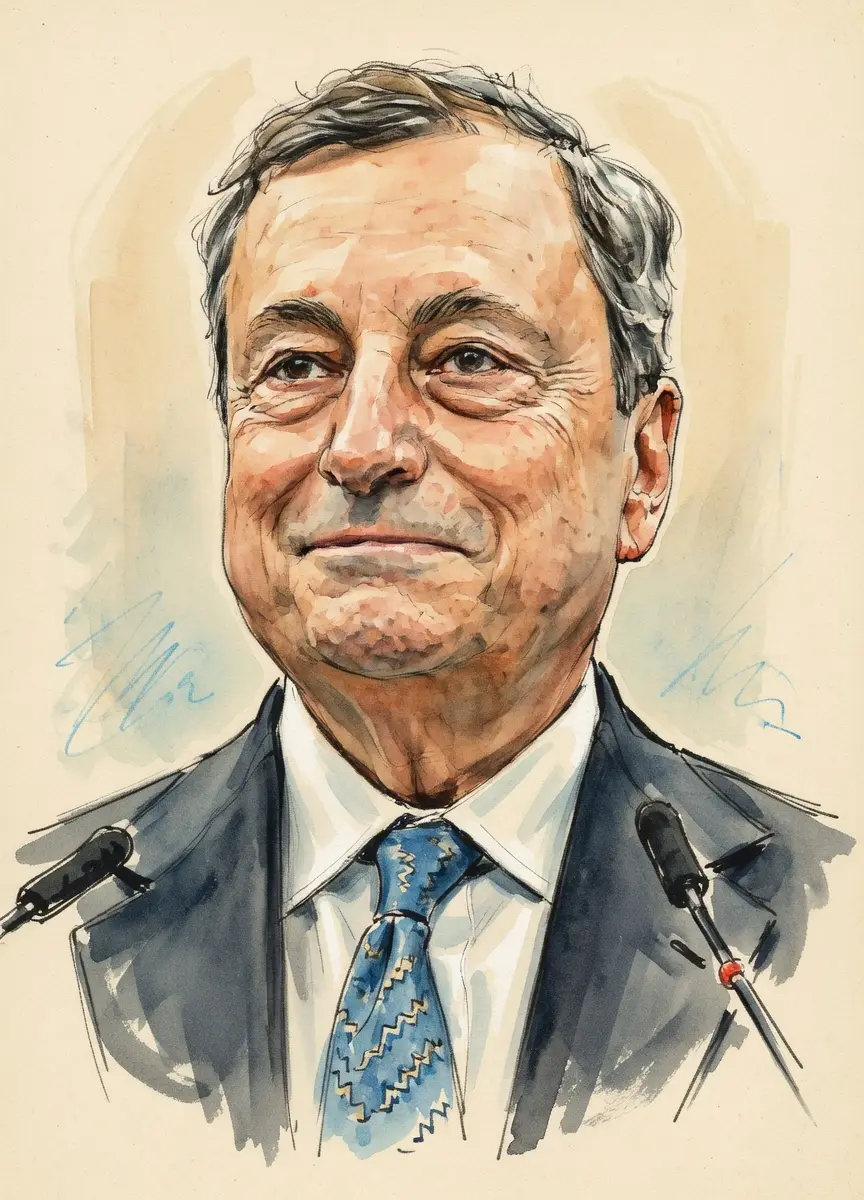
Mario Draghi on Productivity
TL;DR
Mario Draghi views decisively boosting European productivity through massive, coordinated investment as fundamental for future prosperity and security.
Key Points
The report emphasizes that raising productivity is fundamental for freeing funds for redeployment, affordability, and enabling the net-zero transition.
He urged the EU to foster significantly more investment, proposing new prudential rules for banking and institutional investors to facilitate riskier but potentially high-return investments.
Draghi's diagnosis pointed to a clear correlation between a standard of living, innovation, R&D intensity, and labour productivity levels.
Summary
Mario Draghi's core position, articulated in his 2024 report on European competitiveness, is that low and stagnant productivity growth is the single greatest threat to the European Union's long-term prosperity and economic security, explaining approximately 70% of the GDP per capita gap with the US as of 2023. He explicitly warned that failure to address this gap risks a "slow agony" for the bloc when compared to economic rivals like the United States and China. His analysis highlights that Europe's declining investment share of GDP and chronic lag in innovative investment, particularly venture capital, are key drivers of this deficit, despite a competitive foundation in basic scientific research and patenting.
To reverse this trend, the report's central implication is the need for unprecedented, coordinated action, suggesting annual investment needs of EUR 750-800 billion, equivalent to 4.4%-4.7% of EU GDP—a rate unseen since the post-war period, surpassing even Marshall Plan levels as a share of GDP. Draghi recommends overcoming EU fragmentation by ensuring spending is concentrated on high-potential areas and pursuing funding for critical projects, such as breakthrough research, grids, and defense, through common European debt instruments, a proposal that immediately sparked political debate. This call for massive investment seeks to restore dynamism and bridge the productivity chasm separating the EU from its global competitors.
Key Quotes
raising productivity is fundamental
we must, as a matter of urgency, improve productivity
Frequently Asked Questions
Mario Draghi's central argument is that the EU's persistently slower economic growth compared to the US is primarily driven by lower productivity, which accounts for the majority of the per capita GDP gap. He sees this lag as an existential challenge to Europe's long-term economic security. Therefore, he strongly advocates for immediate, massive investment to reverse this trend.
The report suggests massive, unprecedented annual investment, around 4.4% to 4.7% of GDP, to boost capital accumulation and innovation. Key policy ideas included pursuing funding for common projects through joint debt, and better concentrating R&D spending where it has the most potential, rather than allowing it to remain dispersed across regions. He also highlighted the need to address the innovation gap, particularly in areas like venture capital.
The report was widely anticipated and its diagnosis of the productivity crisis was taken seriously, with some comparing its scope to the Marshall Plan. While economists generally supported the focus on investment over austerity, there was immediate political pushback on key funding mechanisms like common European borrowing proposed to finance the required productivity-boosting investments.
Sources6
The future of European competitiveness: Report by Mario Draghi
The Draghi report highlights that productivity must be the goal for Europe
To unleash productivity growth in Europe, rewire your operations
Has Mario Draghi heard of the “productivity paradox”? | Philonomist.
Draghi report - Wikipedia
Chartbook 317 Draghi's view of Europe (1): Investment, R&D & the US-EU comparison
* This is not an exhaustive list of sources.