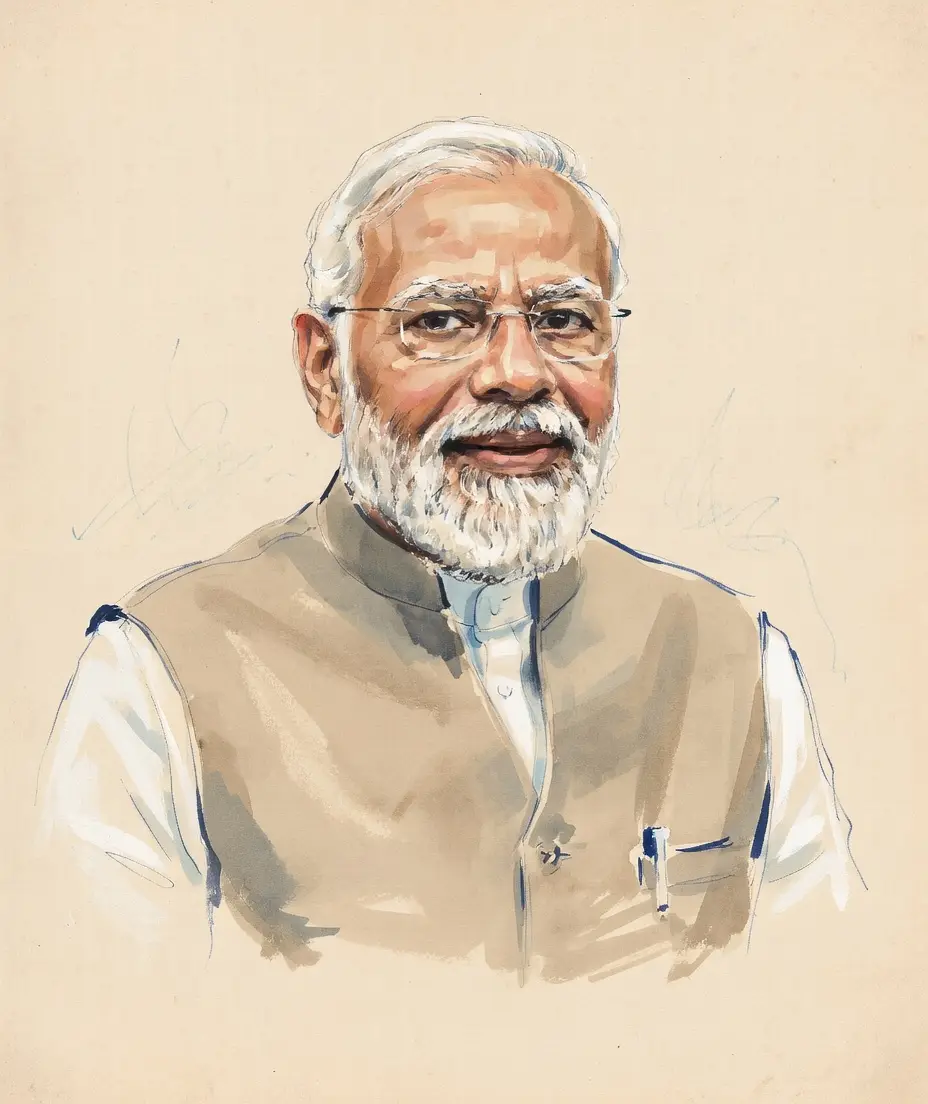
Narendra Modi on Climate Change
TL;DR
Narendra Modi advocates for linking climate action with national development by championing green GDP and emphasizing lifestyle changes for environmental protection.
Key Points
He announced India's 'Panchamrit' goals at COP26 in 2021, including achieving net-zero emissions by 2070.
He suggested developing the concept of a 'green gross domestic product' to redefine development metrics away from high-emission indicators.
He highlighted the importance of a 'Lifestyle For Environment' (LiFE) movement to encourage individual sustainable consumption habits.
Summary
Narendra Modi positions India as a global leader in climate action, framing the national strategy around the 'Panchamrit' commitments announced at COP26 in 2021, which include ambitious targets for non-fossil energy capacity by 2030 and achieving net-zero emissions by 2070. He has described climate change as the world's biggest crisis, arguing that the solution requires a fundamental shift in measuring progress, specifically by suggesting the adoption of a 'green gross domestic product' to move beyond traditional metrics detrimental to the climate. Furthermore, he champions a behavioral shift through Mission LiFE (Lifestyle for Environment), which re-frames climate action as a people-led movement focused on conscious consumption and sustainable lifestyle choices, drawing parallels to ancient Indian ethos.
His approach has evolved from an earlier stance that suggested the climate itself had not changed, to one that highlights India's track record in delivering on Paris Commitments and leading on renewable energy capacity. He continues to advocate for climate justice, demanding that developed nations fulfill their climate finance obligations, and he seeks to position India as a model for low-carbon development coexisting with economic growth. The government has also pursued practical, innovation-led solutions, such as promoting bio-CNG from agricultural waste and launching the Global Biofuels Alliance.
Key Quotes
"For me, this is a moral issue. You don't have a right to exploit what belongs to future generations. We are only allowed to milk the earth, not to kill it."
Frequently Asked Questions
Narendra Modi describes climate change as the biggest crisis facing the world today and views India as a key leader in addressing it. His position centers on balancing development with environmental responsibility, promoting innovation, and encouraging individual lifestyle changes.
Yes, his public stance has evolved; initially, in 2014, he famously stated that 'the climate has not changed. We have changed,' which drew criticism. Since then, he has strongly committed India to concrete, measurable targets like reaching 500 GW of non-fossil energy capacity by 2030.
The Prime Minister has stated that current metrics for measuring progress, such as steel and energy consumption, are detrimental to the climate. He suggested promoting the concept of a green GDP to incorporate environmental consequences into the measure of economic growth.
Sources8
Climate change: PM Modi says it's time to redefine development metrics, promote green GDP | India News - Times of India
Climate change was a hidden force in India's elections. Now Modi needs to deliver solutions.
The miseducation of Narendra Modi on climate change
PM Modi describes climate change as biggest crisis; says, solution lies in sustainable lifestyle | DD News On Air
India's Climate Change Policy in a Modi Government | Brookings
#Climate Change | Prime Minister of India
Planet and People First: India's Climate Model for the World
National Statement by Prime Minister Shri Narendra Modi at COP26 Summit in Glasgow
* This is not an exhaustive list of sources.