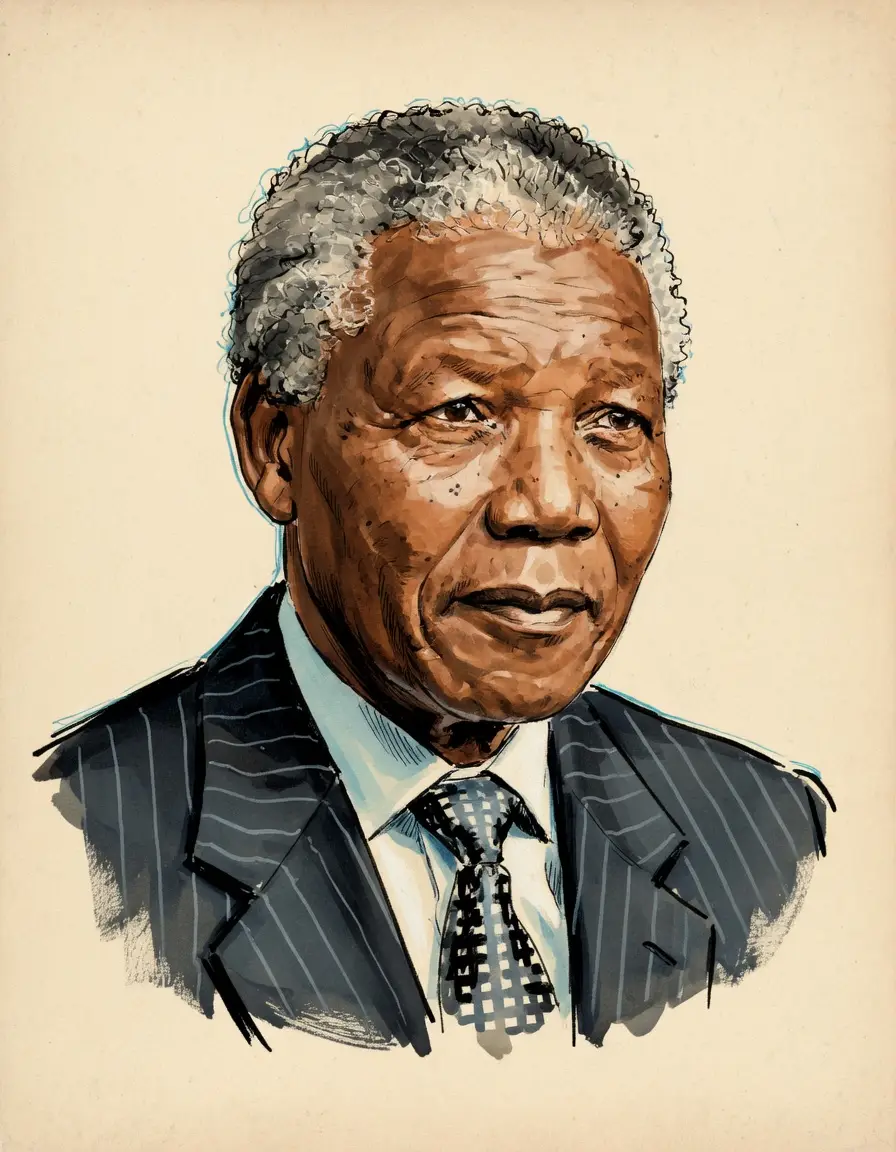
Nelson Mandela on Justice
TL;DR
Nelson Mandela championed a comprehensive justice that included equality, human dignity, reconciliation, and eradication of poverty for all citizens.
Key Points
He declared in his 1994 Inaugural Address that there must be justice, peace, work, bread, water, and salt for all South Africans.
He stated that a nation should be judged by how it treats its lowest citizens, not its highest ones.
He believed that reconciliation required a concerted effort to remove the real roots of past conflict and injustice, not just words.
Summary
Nelson Mandela articulated a vision of justice that extended far beyond mere legal or criminal proceedings; he viewed it as intrinsically linked to human rights, equality, and the eradication of systemic oppression and poverty. His definition encompassed the right to participate in law-making, guaranteed constitutional rights, and confidence in courts that applied law impartially, stating clearly that without these safeguards, the concept of equality before the law was meaningless for the disenfranchised. He fought against both white and black domination, cherishing an ideal of a democratic and free society where all could live in harmony with equal opportunities, an ideal he was prepared to die for.
His conception of justice evolved to strongly incorporate reconciliation, insisting that nation-building required acknowledging the truth of the past, rather than seeking simple retribution or engaging in pious words without action. He specifically framed overcoming poverty as an act of justice, not charity, asserting that freedom could not be complete while gross inequality persisted. The ultimate goal was to create a just and inclusive future, which involved a commitment to social restructuring and transforming the attitudes that underpinned past oppression, ensuring that colour or race became merely a gift, not a status determinant.
Frequently Asked Questions
Nelson Mandela believed justice required more than just the absence of conflict; it demanded the creation of an environment where all people could flourish with dignity and equal opportunity. He stressed that overcoming poverty was an essential act of justice, not charity, and that true justice included reconciliation and healing from past trauma.
Mandela's view of justice encompassed both, but his emphasis was on a broader social justice. He considered criminal justice elements like constitutional rights and fair court access, but his primary goal was a fundamentally just society free from structural discrimination and poverty.
He asserted that justice would be achieved through disciplined mass action, reconciliation, and avoiding retribution in favor of mercy and nation-building. He maintained that the struggle for justice was his life's work, requiring dedication until freedom and equality were secured for everyone.
Sources6
12 Inspiring Nelson Mandela Quotes
Quotes by Nelson Mandela (Author of Long Walk to Freedom)
Nelson Mandela: Icon for Justice | Trinity Washington University
Nelson Mandela's Life & His Statements Speaking Out For Justice
MEMORY FOR JUSTICE - Nelson Mandela Foundation
Nelson Mandela Quotes About Justice | A-Z Quotes
* This is not an exhaustive list of sources.