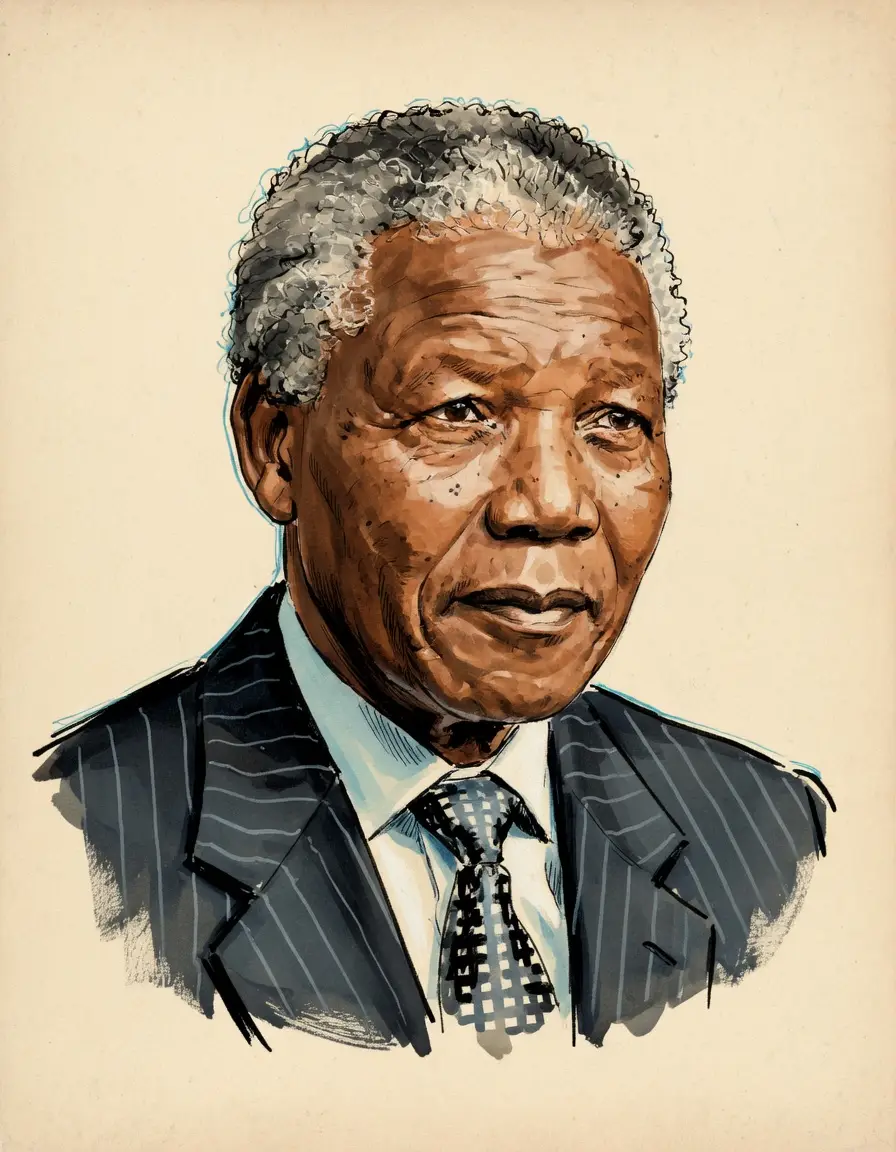
Nelson Mandela on Non-Violence
TL;DR
Nelson Mandela initially embraced non-violence, later adopting sabotage only when peaceful channels were exhausted by the state.
Key Points
The ANC adhered strictly to a constitutional struggle and policy of non-violence for thirty-seven years, until 1949.
He admitted to planning sabotage as the first act of armed struggle, specifically choosing it to avoid loss of life, beginning in December 1961.
In a 2004 message, he stated that no form of violence can ever be excused in a society that wishes to call itself civilized.
Summary
Nelson Mandela's core position on non-violence was rooted in the African National Congress (ANC) tradition, which emphasized constitutional struggle and peaceful, though sometimes unlawful, demonstrations like the Defiance Campaign. He and his colleagues initially chose to answer government force with controlled violence, specifically sabotage, only after realizing that fifty years of non-violence had resulted only in more repressive legislation and the closure of all peaceful protest avenues. He maintained that this decision, which led to the formation of Umkhonto we Sizwe, was not taken lightly, but rather as a morally obligatory step when facing inevitable violence from the oppressive regime.
His approach evolved significantly, moving from strict adherence to non-violence to a pragmatic justification for armed struggle, specifically targeting economic infrastructure to avoid loss of life and minimize future racial bitterness. Even after adopting violence, he continually aimed to avoid civil war and sought a negotiated resolution, famously refusing conditional release that required renouncing violence while the government remained armed. Later in life, as president, he championed peace and non-violence, appealing for dialogue and reason to resolve global differences.
Key Quotes
I have cherished the ideal of a democratic and free society. It is an ideal which I hope to live for and to achieve. But if needs be, it is an ideal for which I am prepared to die.
I planned it as a result of a calm and sober assessment of the political situation that had arisen after many years of tyranny, exploitation, and oppression of my people by the whites.
Frequently Asked Questions
Nelson Mandela's position evolved from an early, principled adherence to non-violence as part of the ANC's initial strategy to a pragmatic decision to resort to controlled violence when peaceful protest was entirely blocked by the apartheid state. After imprisonment, he strongly advocated for peace and negotiation as the path to democracy and reconciliation.
Yes, the stance changed significantly; he shifted from advocating strictly non-violent methods, which he felt had failed, to co-founding Umkhonto we Sizwe, the ANC's armed wing, in 1961. However, he only agreed to this armed struggle as a defensive measure and always maintained a political preference for peaceful change.
He stated that the decision to use violence, specifically sabotage, was made only after careful assessment when all lawful modes of opposition had been legislated against by the government. He felt morally obliged to continue the fight, believing that without responsible leadership controlling armed action, uncontrolled terrorism would erupt.
Sources5
I Am Prepared to Die" (Nelson Mandela's Statement at the Rivonia ...
Nelson Mandela – Nobel Lecture - NobelPrize.org
Nelson Mandela as a Strategist - The Strategy Bridge
Message by Nelson Mandela to the Global Convention on Peace and Non-violence, New Delhi - India
Nelson Mandela (April 20, 1964): I have cherished the ideal of a ...
* This is not an exhaustive list of sources.