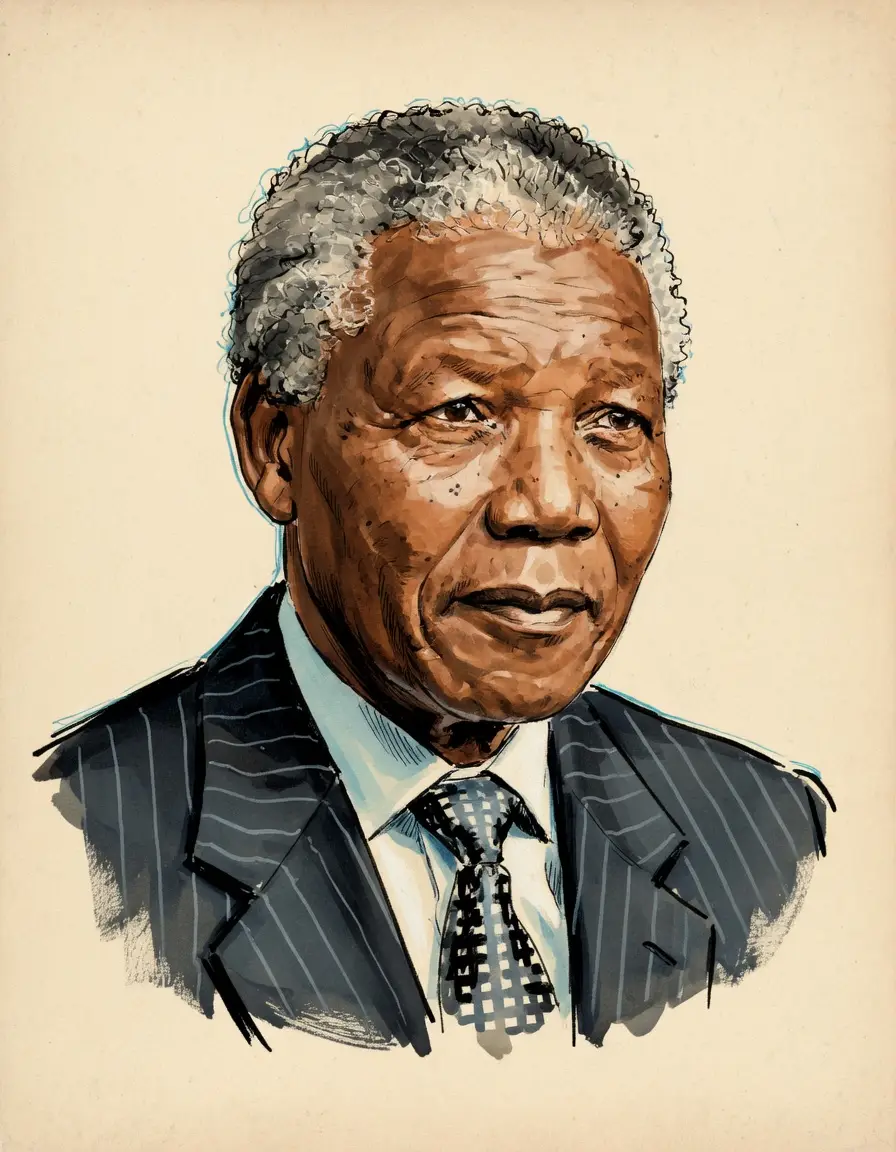
Nelson Mandela on South Africa
TL;DR
Nelson Mandela championed the creation of a unified, democratic, and non-racial South Africa built upon reconciliation and the rule of law.
Key Points
He led South Africa's transition from apartheid to democracy, becoming the country's first Black head of state in 1994.
Mandela created the Truth and Reconciliation Commission to investigate past human rights abuses committed under apartheid.
After retiring, he devoted time to combating poverty and HIV/AIDS, emphasizing that overcoming poverty is an act of justice.
Summary
Nelson Mandela's core position on South Africa was the complete dismantling of the apartheid system and the establishment of a multiracial democracy based on equality and the rule of law. He dedicated his life, including 27 years in prison, to this ideal, eventually leading the negotiation efforts that ended white minority rule. His administration prioritized national reconciliation, exemplified by his symbolic gestures toward former adversaries, and created the Truth and Reconciliation Commission to investigate past human rights abuses.
Following his presidency, his focus shifted to combating persistent issues like poverty and HIV/AIDS, often using his moral authority to push for equitable solutions. While his government retained some economic frameworks inherited from the previous regime, he stressed that true freedom required meeting the basic needs of all citizens, arguing that overcoming poverty was an act of justice, not charity. Despite criticisms regarding the pace of economic transformation, his enduring legacy remains the foundation of a robust, non-racial democracy built on constitutional principles.
Frequently Asked Questions
Nelson Mandela's primary goal for South Africa was to establish a democratic, non-racial society where all persons could live together in harmony with equal opportunities. This required dismantling the apartheid system entirely, which he achieved through negotiation and his subsequent role as the first democratically elected president.
Mandela actively pursued national reconciliation by engaging with former adversaries, such as meeting with the widow of apartheid's chief architect and publicly supporting the traditionally white national rugby team. He saw reconciliation as foundational to the nation-building process and integral to preventing a civil war.
Yes, Nelson Mandela's position on political methods evolved significantly over his life. He initially committed to non-violent protest but co-founded the armed wing Umkhonto we Sizwe due to the government's intransigence, later returning to a non-violent path of negotiation for the transition.
Sources7
Nelson Mandela - Wikipedia
The Inspirational Legacy of Nelson Mandela in South Africa
Here are 11 of Nelson Mandela's most inspirational quotes
Belonging in South Africa
How Mandela Changed South Africa
Nelson Mandela's Life & His Statements Speaking Out For Justice
The story of Nelson Mandela
* This is not an exhaustive list of sources.