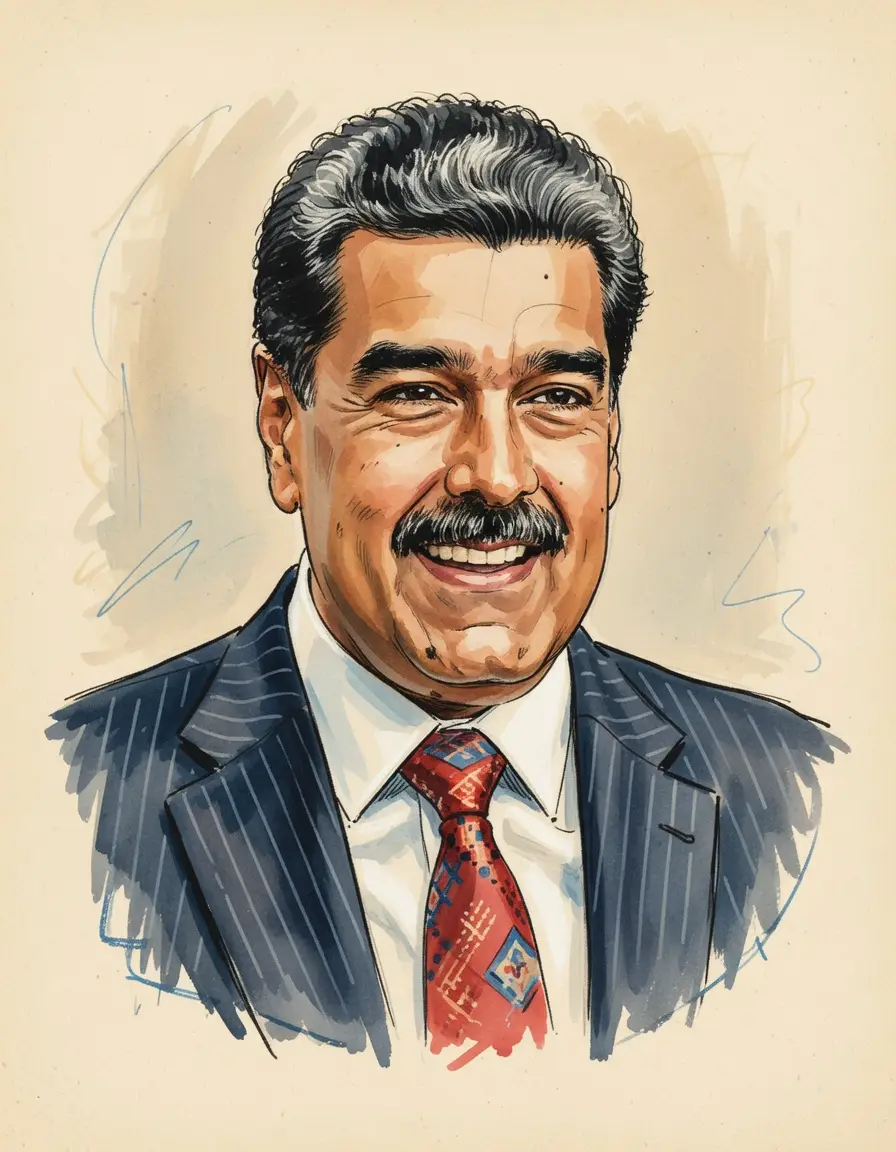
Nicolás Maduro on Socialism
TL;DR
Nicolás Maduro strongly adheres to the ideology of Bolivarian Socialism, seeking its radicalization through communal organization and anti-imperialist struggle.
Key Points
He states that the revolution must be radicalized through the commune structure, viewing it as an essential step toward the communal state.
Maduro frames his government's actions, including trade relationships, within a broader context of fighting against Western imperialism.
The government has promoted an ideological path defined by a synthesis of the Bolívar-Chávez Doctrine with Gramscian and Leninist thought.
Summary
Nicolás Maduro views his political project as a continuation and radicalization of Bolivarian Socialism, a path established by his predecessor, Hugo Chávez. He frequently frames his governance and Venezuela's challenges within an anti-imperialist struggle, positioning the nation against external powers, particularly the United States. Maduro has articulated that the revolution must be deepened through the commune structure, which he sees as an intermediate step toward a communal state that eventually dissolves, aligning with Marxist-Leninist ideals for a classless society.
His application of these principles has involved advocating for communal circuits as a tactic to strengthen the communal project, even while the government faces severe economic challenges and international sanctions. Supporters argue that he is correctly advancing the revolution by focusing on communal organization, emphasizing the goal of achieving a new popular hegemony that bypasses traditional power structures and moves beyond mere capitalism with a human face. However, critics often contend that his actual economic policies have become neoliberal, that he employs socialist aesthetics purely for political benefit, and that his rule is marked by authoritarianism rather than the promised socialist transformation.
Frequently Asked Questions
Nicolás Maduro positions himself as a follower and promoter of Bolivarian Socialism, which he seeks to advance by radicalizing the process through communal organization. He often ties this ideology to anti-imperialist principles, viewing it as a necessary defense against foreign interference. While he cites Marxist-Leninist contributions, his interpretation remains tied to the specific Venezuelan revolutionary project initiated by Hugo Chávez.
The perception of Maduro's ideological shift is debated; some external analysts claim his economic policies have become neoliberal and pragmatic, involving dollarization and openness to capital. However, his supporters maintain that he is correctly navigating complex contradictions while staying committed to the anti-imperialist and communal goals of the original socialist project. Maduro himself continues to publicly embrace the socialist framework.
Maduro emphasizes the construction of a new popular hegemony through grassroots structures, specifically the communal councils and communes, as an intermediate step. He frames this as a necessary transition away from top-down government toward a participatory democracy rooted in the local organization of production and decision-making. This structure is presented as the path for contemporary Bolivarian Socialism.
Sources8
Nicolás Maduro: Marxist, Christian, Bolivarian : r/socialism - Reddit
Socialism: A Case Study on Venezuela - The Policy Circle
Solidarity with Venezuela's Left Opposition | Transnational Institute
Nicolás Maduro - Wikipedia
Venezuelan Tragedy: Socialism, Entitlement, and Tyranny Are Connected | The Daily Economy
How Socialism Destroyed Venezuela - Manhattan Institute
Rep. Burlison Issues Statement on Arrest of Nicolás Maduro and the Failure of Socialism
* This is not an exhaustive list of sources.