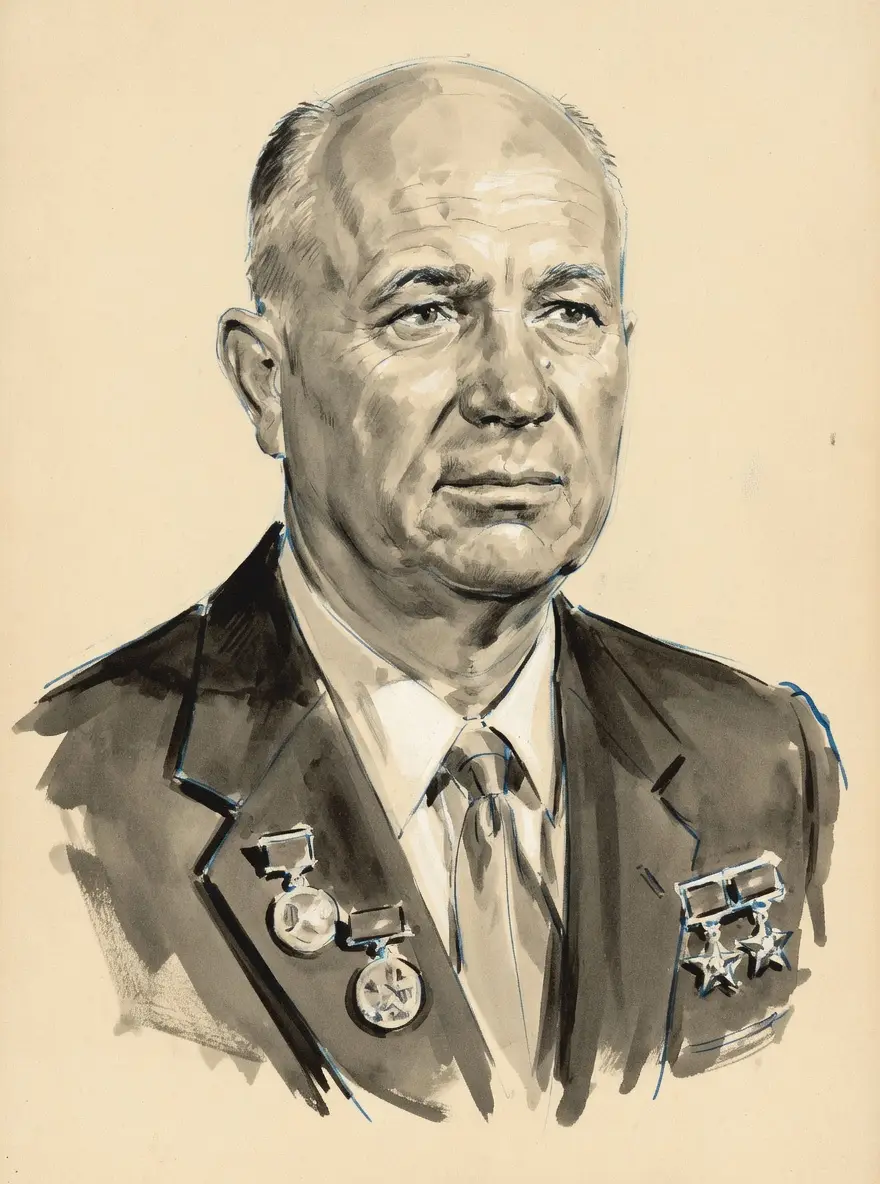
Nikita Khrushchev on India
TL;DR
Nikita Khrushchev viewed India as an influential non-aligned state and sought its friendship through economic aid and shared anti-imperialist sentiment.
Key Points
During his 1955 visit, Khrushchev publicly supported India's sovereignty over Kashmir, stating the decision had been made by its people.
He criticized the West's military alliances and their policy of 'position of strength,' which he viewed as undermining peace efforts.
Khrushchev vocally condemned Portuguese colonialism in Goa, framing it as an imperialist holdout that needed to be liberated into India.
Summary
Nikita Khrushchev's position on India was largely positive and strategic, viewing the large, newly independent democracy as a crucial non-aligned state to court away from Western influence during the Cold War. His celebrated 1955 visit, alongside Premier Bulganin, was instrumental in developing a new Soviet diplomatic style focused on ideological competition through developmental aid and cultural outreach. He emphasized that the Soviet Union wished for India to develop heavy industry and raise living standards, contrasting this with what he saw as the slow capitalist path proclaimed by its Prime Minister, while stressing that Soviet assistance was disinterested and without political strings attached.
Despite initial goodwill and shared anti-colonial rhetoric that proved highly successful when capitalizing on issues like the Portuguese presence in Goa, tensions arose when Khrushchev defended the retention of Soviet nuclear weapons as a necessary deterrent against the West, which clashed with India's commitment to peaceful coexistence. While Khrushchev sought to present the USSR as an Asian power and a genuine friend, his ultimate goal was to ensure India factored into Moscow's geopolitical strategy against Washington and Beijing, making the relationship one of mutual convenience cemented by strategic convergences.
Key Quotes
I know what it means to work for other people. I am one of you. I worked in mines for France, Britain and Germany and so I know what benefit we get by working for others.
Frequently Asked Questions
Nikita Khrushchev held a largely positive view of India, seeing it as a critical non-aligned state whose friendship was valuable in the global Cold War contest against the West. He aimed to cultivate this relationship through offering substantial economic and technical assistance.
He employed a personal charm offensive, contrasting his own peasant background with Western elites, and publicly embracing Indian customs like wearing garlands and using the 'namaste' greeting. This public relations effort targeted the masses to promote the appeal of the Soviet development model.
Khrushchev expressed support for the ultimate ban on nuclear weapons, aligning with India's peaceful coexistence principle, but he simultaneously justified the Soviet Union's continued testing and development of the H-bomb as a necessary deterrent against the West. This contradiction drew criticism from Indian elites.
Sources7
Nikita Khrushchev on early Russian impressions of India - Russia Beyond
The Main Drivers of Soviet Foreign Policy Towards India, 1955–1991
India–Soviet Union relations - Wikipedia
Nikita Khrushchev, 1955: We wanted India to develop heavy industry but not by the methods Nehru was proclaiming... the people of India would be doomed for many years to an impoverished existence. : r/IndiaSpeaks
Finding Their Voice: The Indian Press and Nikita Khrushchev's 1955 Visit to India
The 1962 Sino-Indian War and the Cuban Missile Crisis | Hoover Institution
The Main Drivers of Soviet Foreign Policy Towards India, 1955–1991
* This is not an exhaustive list of sources.