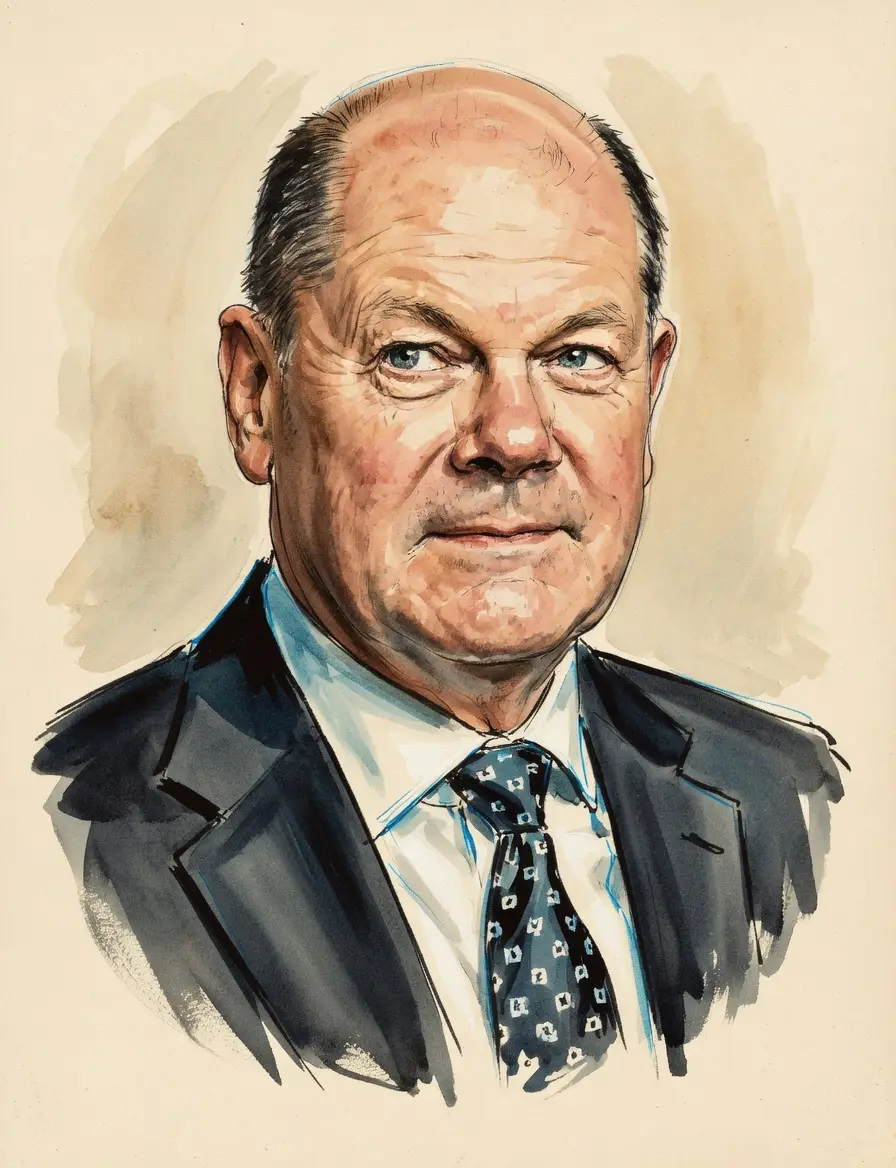
Olaf Scholz on Political Ideology
TL;DR
Olaf Scholz advocates for a pragmatic, continuously reconciling politics that balances universal moral norms with the constraints of political reality.
Key Points
He described his strategy on Ukraine support as a 'difficult balancing act' between aiding Ukraine and avoiding unintended escalation with Russia.
His rhetoric moves away from pure realism by insisting that the international order must be based on rules, rejecting 'the law of the strong.'
In a pre-war survey context, most German respondents located Chancellor Olaf Scholz in the center of the ideological spectrum, not on the far-left.
Summary
Olaf Scholz's political ideology, particularly regarding foreign policy and crisis management like the war in Ukraine, is characterized by an attempt to reconcile abstract moral values with the practical constraints of political reality. His approach is not built around a single, stable conceptual core like some of his counterparts, but rather involves a pragmatic back and forth, which is better understood as an argumentative method for justification rather than a fixed ideology. Key to his stance is the concept of political judgment, which he employs to continuously adapt principles to evolving circumstances, even while asserting that the underlying moral principles do not change.
This position is distinct from both pure moralism and pure realism; while he invokes universal values such as human rights, freedom, and the rule of law, he simultaneously emphasizes necessity, stability, and interest, arguing for a 'principled Realpolitik' that resists becoming the 'dominion of the strong over the weak.' The implication is that Scholz views realism less as a substantive ideology and more as a necessary tool for applying and accommodating moral norms within the messy context of global politics, suggesting that political judgment is essential when 'textbook' or 'blueprint' approaches fail.
Frequently Asked Questions
Olaf Scholz's position is best described as pragmatic and centrist, focused on reconciling competing demands rather than adhering to a single, rigid ideology. He seeks a continuous balance between upholding universal moral principles and acknowledging the necessities of political reality and realism.
He integrates realist concepts like stability and necessity into his framework, employing what he terms a 'principled Realpolitik.' However, he insists that realism must be constrained by shared norms and the rule of law, not used to justify the 'dominion of the strong over the weak.'
His approach is consistently characterized by a commitment to navigating the middle ground, suggesting an evolution is less about changing core ideology and more about applying his pragmatic balancing act to new crises. This context-sensitive application of norms has been a feature of his political style.
Sources6
Full article: Political thinking in action: realism as ideology ...
Germany Divided: Policy Polarization Belies Centrist Self- ...
Olaf Scholz having a rare philosophical moment on the ...
Shifting Tides: The Far-Right's Rise and Germany's ...
Germany's Scholz 'relieved' far right did not win French ...
Are ideological and partisan affinities determining voters ...
* This is not an exhaustive list of sources.