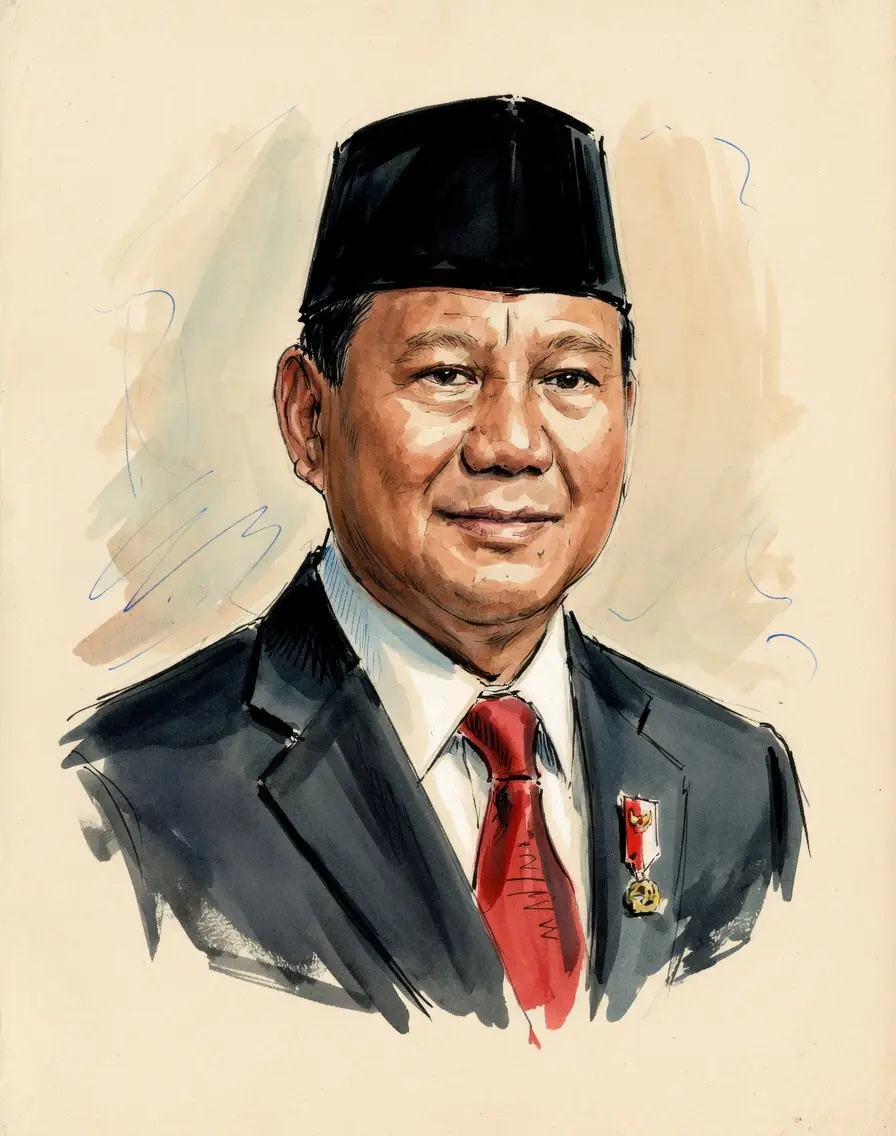
Prabowo Subianto on Foreign Policy
TL;DR
Prabowo Subianto pursues an active, transactional foreign policy shifting from non-alignment toward pragmatic multi-alignment with major powers.
Key Points
He embraced the concept of "multi-alignment," stating that being strictly non-bloc leaves the country vulnerable, which contrasts with the prior administration's caution about alignment.
The administration caused controversy by issuing a joint statement with China in November 2024 that was perceived as implicitly acknowledging the nine-dash line claim in the South China Sea.
Prabowo advanced cooperation with the European Union by signing the Indonesia-EU Comprehensive Economic Partnership (CEPA) despite previously stating Indonesia did not need the EU.
Summary
Prabowo Subianto, as President, has adopted an ambitious foreign policy agenda characterized by high-profile engagement across the globe, which analysts have described as "multi-alignment," a shift away from the traditional non-aligned doctrine. This approach prioritizes enhancing good relations with all great powers, including both the United States and China, justifying the strategy by asserting that in a hostile world, strong friendships with many partners are necessary for security. This transactional diplomacy is evident in actions such as joining BRICS, engaging in two-plus-two talks with China, and negotiating significant trade concessions with the United States to counter tariff pressures. Despite this active engagement, critics suggest the foreign policy lacks clear direction, with grand narratives often disconnected from regional substance, leading to a perception of drift over strategy.
This style involves a personalization of foreign policy, where direction is tied to the president’s personal inclinations rather than strictly adhering to established institutional frameworks, which has led to instances of miscommunication, such as a controversial joint statement with China regarding the South China Sea. While the President projects an image of a global leader through assertive rhetoric regarding issues like the Gaza conflict and engagement with the Muslim world, practical execution has been inconsistent, sometimes overlooking pressing regional concerns like ASEAN coordination or the Rohingya crisis. The approach is seen as a recalibration based on material interest and tactical flexibility, but it risks complicating relationships with partners by making Jakarta’s intentions dependent on a shifting calculus, potentially eroding trust and regional leadership.
Key Quotes
we no longer need the European Union
Frequently Asked Questions
Prabowo Subianto’s core approach is described as an active, transactional foreign policy focused on multi-alignment rather than traditional non-alignment. He seeks to maximize Indonesia's interests by building relationships with multiple great powers, including both the US and China. This strategy is driven by the belief that the world is hostile and one must secure friends everywhere to avoid suffering.
Yes, his current stance represents an evolution from his past rhetoric, which sometimes included strong anti-Western imperialist language. As President, he has shown a willingness to compromise and cooperate with Western powers, such as advancing the CEPA agreement with the EU, despite earlier fiery anti-Western statements made while campaigning.
Prabowo Subianto justifies his multi-alignment by arguing that in an era of great power rivalry, Indonesia cannot afford to be entirely on its own. He advocates for strengthening ties with all major powers using the maxim, "a thousand friends is too few, one enemy is too many," to hedge against potential threats.
Sources5
Indonesia's Gado-Gado Foreign Policy – A Look at Developments Under Prabowo Subianto's Leadership
Indonesia's multi-alignment dilemma under Prabowo
Six Months of Prabowo: Indonesia's Diplomatic Charm Offensive
An Analysis of Indonesia's Foreign Policy under Prabowo: Managing Great Power Relations
* This is not an exhaustive list of sources.