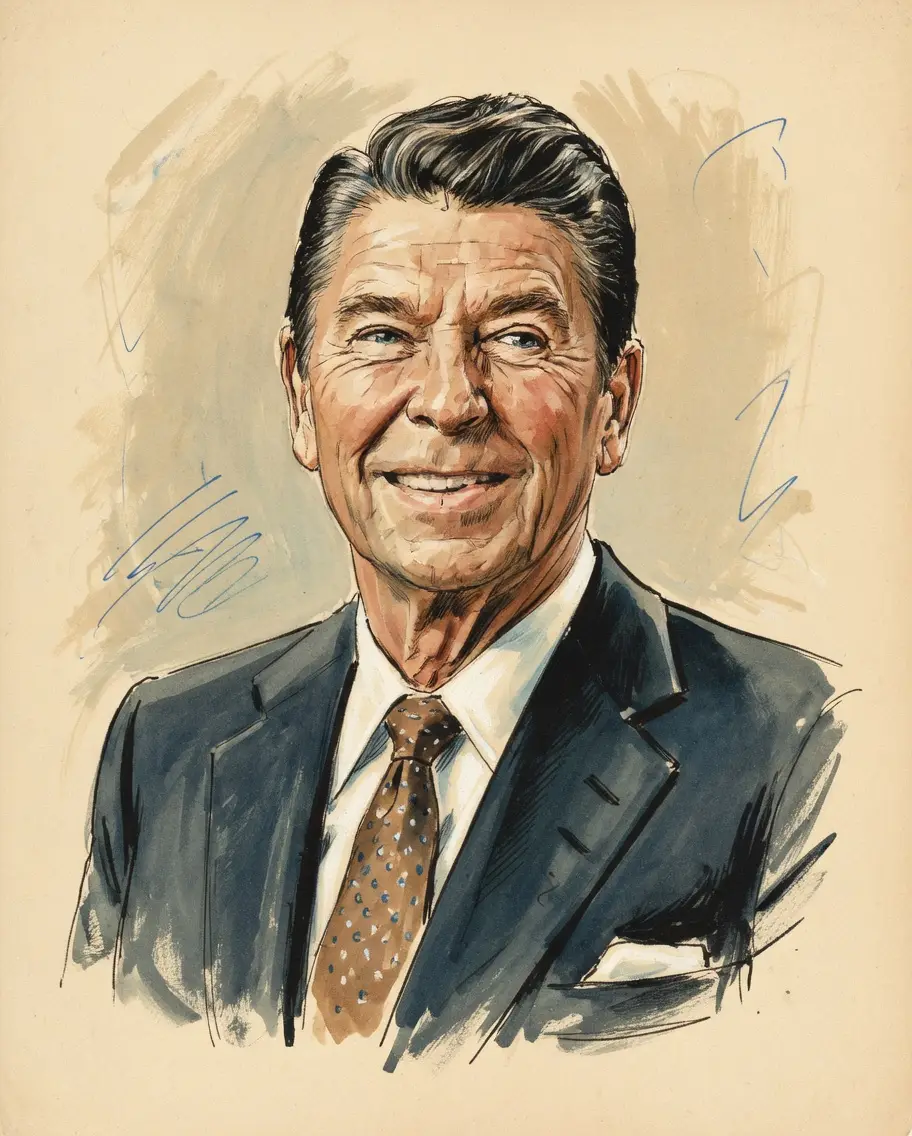
Ronald Reagan on China
TL;DR
Ronald Reagan sought strategic partnership with the People's Republic of China while staunchly maintaining security commitments to Taiwan.
Key Points
He visited the People's Republic of China on April 26, 1984, meeting with Chinese President Li Xiannian.
Prior to his presidency, Reagan stated in 1980 that friendship with the PRC could be pursued without jeopardizing the U.S. relationship with the Republic of China (Taiwan).
During his 1984 visit, he noted the positive effect of the Chinese economy beginning to allow farmers and workers to keep the fruits of their labor.
Summary
Ronald Reagan's position on China centered on pursuing good relations and cooperation with the People's Republic of China (PRC) while upholding commitments to Taiwan, the Republic of China (ROC). He viewed engagement, particularly in areas like trade, technology, and cultural exchange, as mutually beneficial and a positive step toward world peace and stability. His administration concluded an agreement on the peaceful uses of nuclear energy and sought to expand commerce, seeing mutual interests even with a competitor nation. He stressed that friendship must be based on acknowledging differences rather than fiction to be durable.
However, this engagement was fundamentally qualified by his unwavering commitment to the defense of Taiwan, as codified in the Taiwan Relations Act. Reagan was critical of the prior administration's handling of normalization, believing it involved unnecessary concessions that jeopardized Taiwan's security. He pledged to enforce the Act, which mandates providing defensive weapons to Taiwan and treating relations with the ROC as official, while simultaneously working to treat all Chinese officials with fairness and dignity. This created a dual-track approach: pragmatic partnership with the mainland and firm support for the island's security.
Key Quotes
We went to China to advance the prospects for stability and peace throughout the world.
A nuclear war cannot be won and must never be fought.
Frequently Asked Questions
Ronald Reagan's main goal was to advance the prospects for stability and peace through increased understanding and cooperation between the United States and the Chinese leadership. He desired a strategic relationship based on mutual respect, even while acknowledging fundamental differences between the two political systems. He felt progress was achievable through expanded trade and cultural ties.
The former President was resolute in his intent to observe the Taiwan Relations Act, which mandated providing defensive weapons to Taiwan. He pledged to enforce the law, asserting that commitments to friends must be kept, regardless of pressure from the mainland. He criticized the prior administration for making concessions on this issue during normalization.
While Reagan's administration pursued engagement and noted some positive economic liberalization, his speeches emphasized acknowledging fundamental differences rather than expecting political convergence. He sought to maintain a friendship based on reality, suggesting that a durable relationship required mutual respect for differing values and systems.
Sources7
Remarks Upon Returning From China
Foreign Relations of the United States, 1981–1988, Volume I, Foundations of Foreign Policy Document 9
Ronald Reagan and China: 1984
President Reagan visits China | April 26, 1984 | HISTORY
Ronald Reagan's view of China - Taiwan Today
The China 'End State' Question
* This is not an exhaustive list of sources.