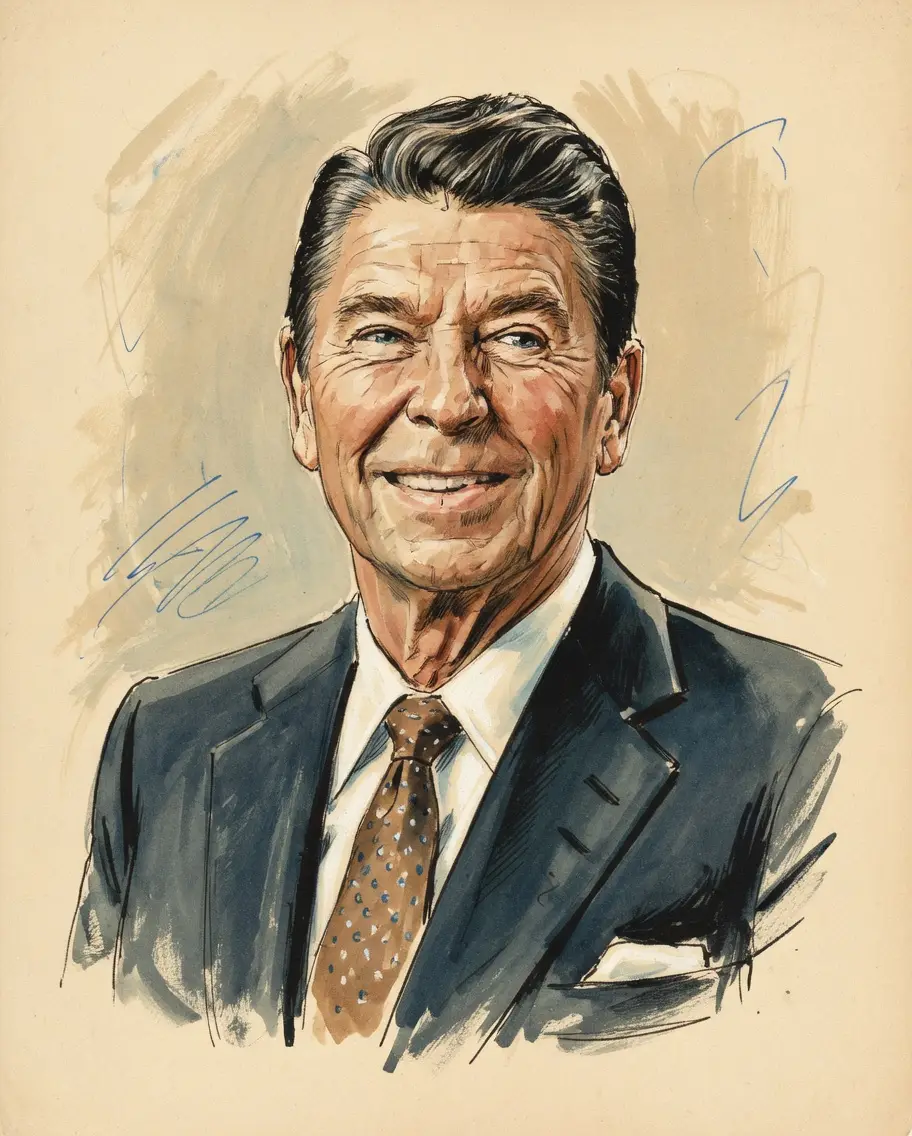
Ronald Reagan on Foreign Policy
TL;DR
Ronald Reagan advocated for peace through strength, building military power to resist adversaries and champion freedom globally.
Key Points
He consistently advocated for restoring America's military strength, increasing the U.S. military budget by 43% over the expenditure during the Vietnam War era.
He promoted the "Reagan Doctrine" by providing overt support to anti-Communist "freedom fighters" struggling against Soviet-backed Marxist regimes, such as in Afghanistan and Nicaragua.
By the end of his term, he achieved a landmark agreement with the Soviet Union, signing the Intermediate-Range Nuclear Forces Treaty in December 1987.
Summary
Ronald Reagan's foreign policy centered on the core principle of achieving peace through demonstrated national strength, believing that weakness tempted adversaries like the Soviet Union to advance their ambitions. Upon taking office, he prioritized rebuilding a demoralized and underfunded U.S. military, increasing the defense budget significantly to restore a "margin of safety" for America and its allies. He regarded Communism as an immoral and destructive ideology, famously labeling the Soviet Union an "evil empire" and the focus of evil in the modern world early in his presidency. This stance was paired with a commitment to resisting Soviet-backed Marxist regimes globally, a policy later termed the "Reagan Doctrine," which involved overt support for anti-Communist groups in places like Afghanistan and Nicaragua.
His approach evolved to include direct engagement with the Soviet leadership, particularly with Mikhail Gorbachev, leading to significant diplomatic breakthroughs despite the initial ideological conflict. While advocating strength and refusing to negotiate under duress, he pursued verifiable arms reduction agreements, resulting in the Intermediate-Range Nuclear Forces (INF) Treaty. Reagan believed that success in foreign affairs required the democracies to recover their strength, stand firm on their values, and speak the truth candidly to adversaries. His overall implication was that steadfastness, not détente alone, ultimately brought the two superpowers to the negotiating table and pushed back the specter of nuclear war.
Key Quotes
I cannot, however, agree to any treaty, including the SALT II treaty, which, in effect, legitimizes the continuation of a one-sided nuclear arms buildup.
Frequently Asked Questions
Ronald Reagan’s primary foreign policy tenet was "peace through strength." He believed that the United States must possess overwhelming military power to deter aggression and secure peace globally. This required a significant rebuilding of the armed forces after perceived declines during the preceding decade.
He viewed the Soviet Union as the "focus of evil in the modern world" and believed Communism was an immoral, destructive ideology bent on world domination. Despite this, he engaged in personal diplomacy with Soviet leaders, believing firmness would lead them to the bargaining table for arms reductions.
Yes, a major accomplishment was the Intermediate-Range Nuclear Forces (INF) Treaty, signed in December 1987 with Mikhail Gorbachev. This treaty was historic because it eliminated an entire class of U.S. and Soviet nuclear missiles, marking a step toward reducing nuclear arsenals.
Sources7
Foreign Policy | The Ronald Reagan Presidential Foundation & Institute
Ronald Reagan: Foreign Affairs | Miller Center
Radio Address to the Nation on United States Foreign Policy
Address by Ronald Reagan - Historical Documents - Office of the ...
* This is not an exhaustive list of sources.