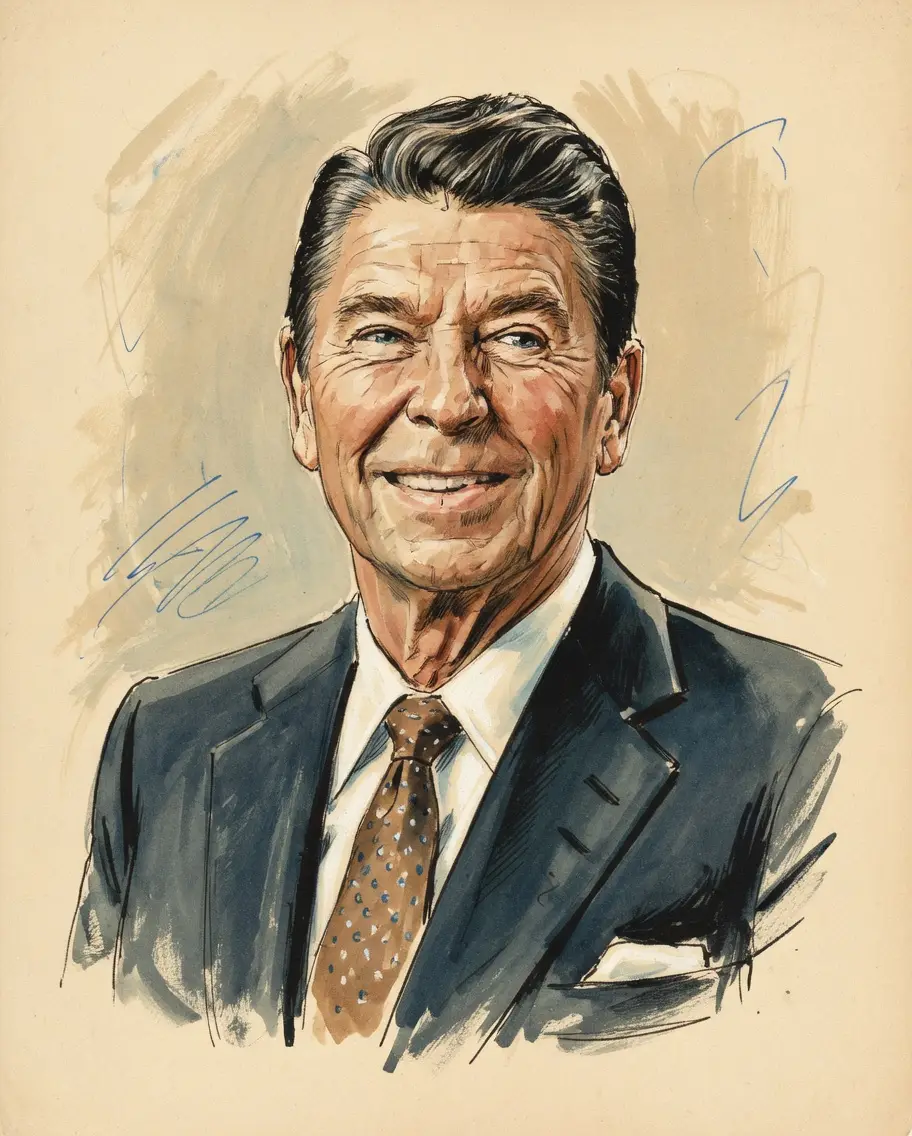
Ronald Reagan on Gorbachev
TL;DR
Ronald Reagan viewed Gorbachev as a necessary partner for historic arms reduction, despite underlying ideological conflict.
Key Points
He handwrote a reply to the first letter from Gorbachev on March 11, 1985, inviting him to Washington to discuss resolving differences through negotiation.
The President and Gorbachev signed the INF Treaty in December 1987, which eliminated ground-launched nuclear missiles with ranges between 500 and 5,000 kilometers.
In his June 12, 1987, speech at the Brandenburg Gate, the President publicly challenged the Soviet leader to, "Mr. Gorbachev, tear down this wall!"
Summary
Ronald Reagan, a staunch anti-Communist, recognized Mikhail Gorbachev as the crucial Soviet leader with whom meaningful progress on arms reduction and U.S.-Soviet relations could finally be achieved. After years of dealing with Soviet leaders who passed away or were unresponsive, Reagan finally found a partner in Gorbachev starting in 1985, leading to five summits designed to reduce mistrust. This engagement resulted in the historic Intermediate-Range Nuclear Forces (INF) Treaty, eliminating an entire class of missiles, and fostered a more positive diplomatic course between the nations.
However, Reagan's posture was a duality of engagement and challenge; while he sought common ground on issues like arms control and regional conflicts, he did not shy away from direct confrontation on ideology and freedom. This is exemplified by his famous 1987 demand for the Soviet leader to literally tear down the Berlin Wall, a statement that some within his own administration feared would jeopardize the relationship. This willingness to push for fundamental change, even while maintaining a functional dialogue, characterized the complex relationship that helped set the terms for the Cold War’s end.
Frequently Asked Questions
Ronald Reagan viewed Mikhail Gorbachev as a necessary partner to fundamentally change U.S.-Soviet relations and achieve significant arms reduction, despite their deep ideological differences. He felt that personal engagement was key to evaporating the mistrust between the two superpowers. The relationship blossomed into the most significant arms reduction treaty in history.
The President was determined to include the line challenging Gorbachev to tear down the Berlin Wall in his 1987 speech, even when advisers urged him to omit it for fear of causing tension. The sentiment behind the demand was inspired by a conversation he had with a West Berlin resident. He ultimately left the line in, despite internal objections.
The most significant concrete result was the signing of the Intermediate-Range Nuclear Forces (INF) Treaty in December 1987, which reduced nuclear arms for the first time. The engagement also fostered a positive course in bilateral relations, leading to continued discussions on strategic nuclear weapons reductions. He concluded his final message to Gorbachev hoping the world was safer than a year prior.
Sources7
“Tear Down This Wall” | National Archives
New Year's Messages of President Reagan and President Mikhail Gorbachev of the Soviet Union
Tear down this wall! - Wikipedia
Mikhail Gorbachev | The Ronald Reagan Presidential Foundation & Institute
The Reagan-Gorbachev Statement: Background to #ReaffirmOurFuture | European Leadership Network
Ronald Reagan's Best Scene | Hoover Institution
Reagan letter to Gorbachev, March 11, 1985 | National Security Archive
* This is not an exhaustive list of sources.