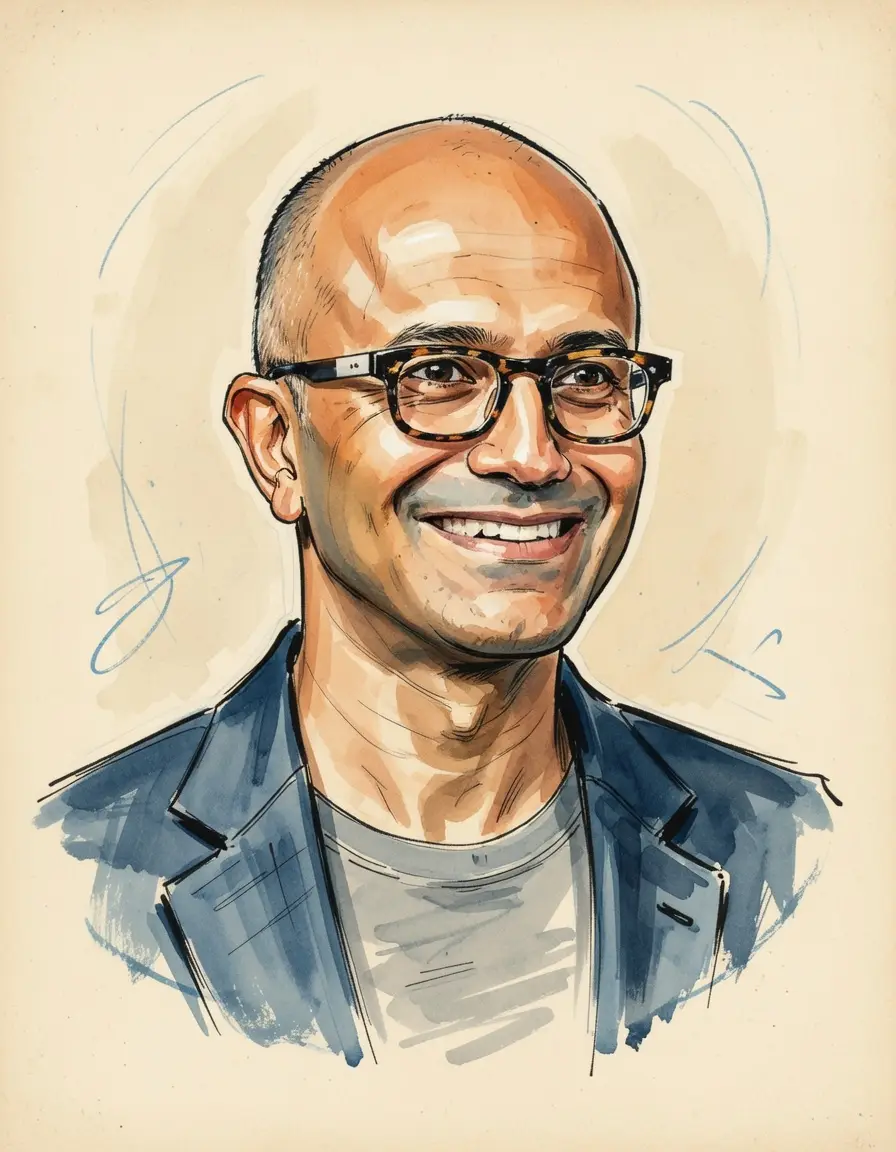
Satya Nadella on Microsoft AI Strategy
TL;DR
Satya Nadella's Microsoft AI strategy centers on massive infrastructure investment, deep partnerships, and widespread integration across all software layers.
Key Points
The success of AI should be measured by its ability to boost global GDP, with a goal benchmark being developed world growth rates of 10%.
Microsoft is committed to ensuring AI benefits reach beyond Big Tech, warning against a potential AI bubble if adoption is not broad and equitable.
He frames strategic partnerships as 'non-zero-sum' opportunities, citing historical reliance on Intel for Windows and the Macintosh for early Office development.
Summary
Satya Nadella is guiding Microsoft's AI strategy with a long-term vision encapsulated by the philosophy of “thinking in decades, executing in quarters,” focusing on driving global economic growth through AI adoption. A core tenet of this strategy is the radical transformation of the tech stack, which necessitates continuous, massive investment in physical infrastructure, with the company operating over 400 data centres globally. He views AI as the fourth major platform wave, following client-server, internet, and cloud, and believes the world requires substantially more compute power to support future AI applications and agents.
His approach emphasizes building foundational strength through infrastructure, prioritizing security and quality, while leveraging strategic alliances like the pivotal one with OpenAI to access cutting-edge model research. Furthermore, the strategy is one of pervasive integration, extending AI via the Copilot family of products across Microsoft 365, GitHub, and other platforms, transforming knowledge work with concepts like “infinite minds” and “macro delegation.” Nadella advocates for a “non-zero-sum” view, stressing that the success of adjacent technology, like partners' work, can serve as a lever for Microsoft’s growth by expanding the total addressable market.
Key Quotes
More than any transformation before it, this generation of AI is radically changing every layer of the tech stack, and we are changing with it.
Frequently Asked Questions
Satya Nadella frames the current period as the AI platform wave, guiding Microsoft with a philosophy of “thinking in decades, executing in quarters.” This balances ambitious, long-term innovation with disciplined, short-term, measurable results. He stresses that AI success must ultimately manifest as broad sectoral productivity gains evidenced in economic growth.
He views infrastructure as the bedrock of the AI strategy, necessitating continuous, major investment in physical data centres across the globe to power the required compute. Nadella notes that even AI agents need robust infrastructure like virtual machines, storage, and compute, making hyperscale operations a crucial competitive advantage.
Nadella supports a 'non-zero-sum' posture where collaboration with adjacent technology providers expands opportunity for Microsoft rather than creating a strictly competitive battle. The partnership with OpenAI is an example of this, where Microsoft supplied compute and commercialization support in exchange for privileged access to foundation models.
Sources9
AI, Ambition, and a $3 Trillion Vision: Satya Nadella on Microsoft's Bold Bet
Microsoft's New Growth Era: Inside Satya Nadella's AI Vision
Satya Nadella is reshaping Microsoft's culture
Microsoft CEO warns AI needs to spread beyond big tech to avoid bubble
Satya Nadella just gave a 1 hour 15 minute...
Microsoft CEO Satya Nadella on AI's Business Revolution: What Happens to SaaS, OpenAI, and Microsoft? | LIVE from Davos
How Microsoft's Data Centres Power Its AI Strategy
Nadella on Non Zero Sum: Openness and AI Ecosystems at Microsoft
* This is not an exhaustive list of sources.