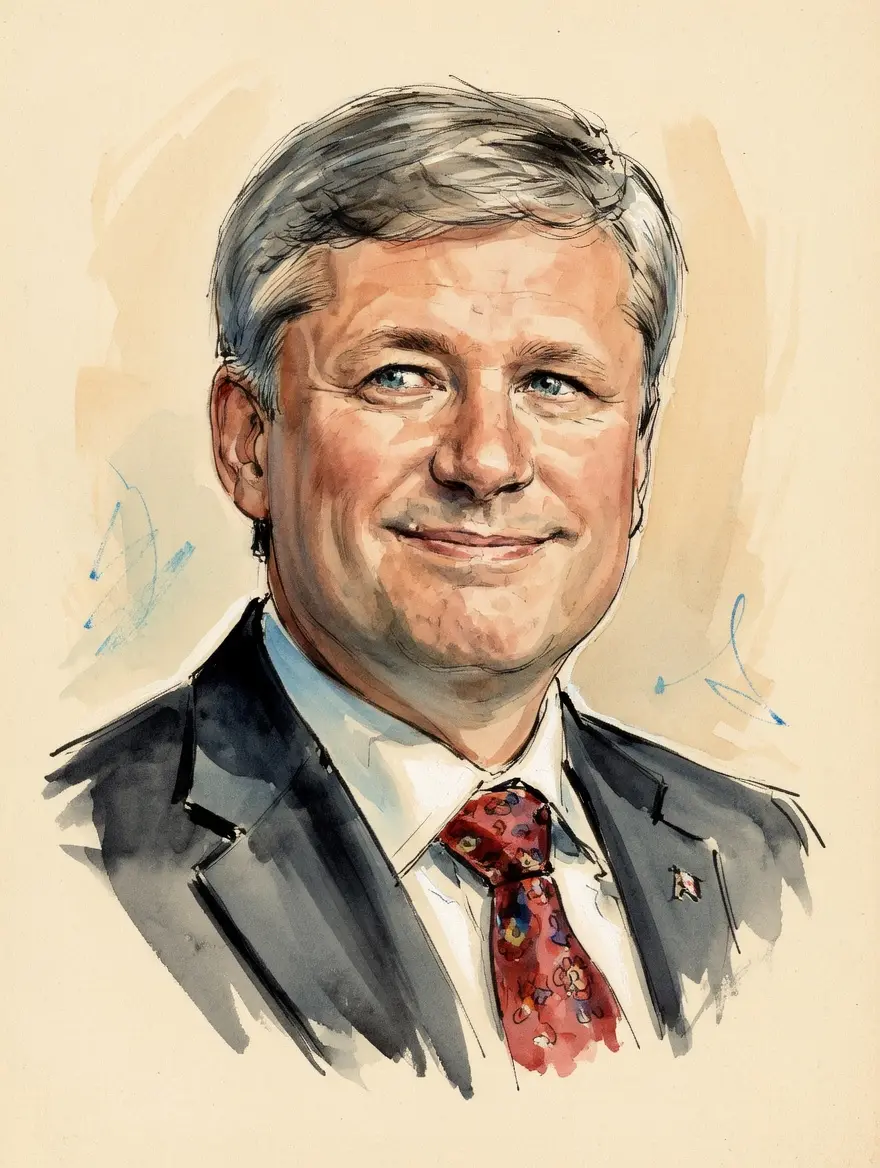
Stephen Harper
- Known for
- 22nd prime minister of Canada, Conservative Party co-founder, Economic management
- Born in
- Leaside, Canada
- Education
- Master's degree in economics, University of Toronto
Stephen Harper is the architect of modern Canadian conservatism, serving as the 22nd Prime Minister of Canada from 2006 to 2015. A former economist and co-founder of the Conservative Party of Canada, his tenure focused on fiscal restraint, conservative social policies, and asserting Canadian sovereignty abroad.
His legacy is defined by shifting the political centre to the right, achieving a majority government in 2011, and presiding over Canada's response to the Great Recession.
Signature Positions
Harper's government enacted several major policy shifts across domestic and foreign affairs:
- Economic Management: Implemented aggressive cuts to the GST and corporate taxes, and reduced the federal deficit significantly by 2015.
- Climate Change: Formally withdrew Canada from the Kyoto Protocol, prioritizing economic growth over international climate targets.
- Israel: Maintained a staunchly pro-Israel stance, even linking Canada's 2010 UN Security Council bid loss to this position.
- Constitutional Issues: Passed the Québécois nation motion to recognize Quebec as a nation within a united Canada.
- Elections/Transparency: Faced controversies like the Robocall scandal and altered the mandatory 2011 Census long-form questionnaire, leading to criticism over transparency.
Notable Tensions
Harper's political career was marked by several key tensions and contradictions:
- Senate Reform: Despite criticizing the Senate as a "dumping ground" for cronies, he made numerous appointments, leading to accusations of Harpocrisy.
- Social Policy: While moving the party away from contentious social issues like same-sex marriage in official platforms, his personal history includes socially conservative views.
- Foreign Policy: Reduced defence spending to 1% of GDP while simultaneously authorizing military interventions, such as in Libya.
- China Policy: Initially criticized for slow engagement with China, his post-premiership views have since hardened, labeling the current era a Second Cold War between the US and China.
As the first leader of the merged Conservative Party, Harper successfully unified the right-of-centre coalition after years of fragmentation from the Reform Party era. He remains a significant figure in global conservatism, now chairing the International Democracy Union.
His tenure contrasts sharply with his successor, Justin Trudeau, particularly in fiscal policy; Harper’s government reduced the budget deficit, while Trudeau’s expanded spending post-2015.