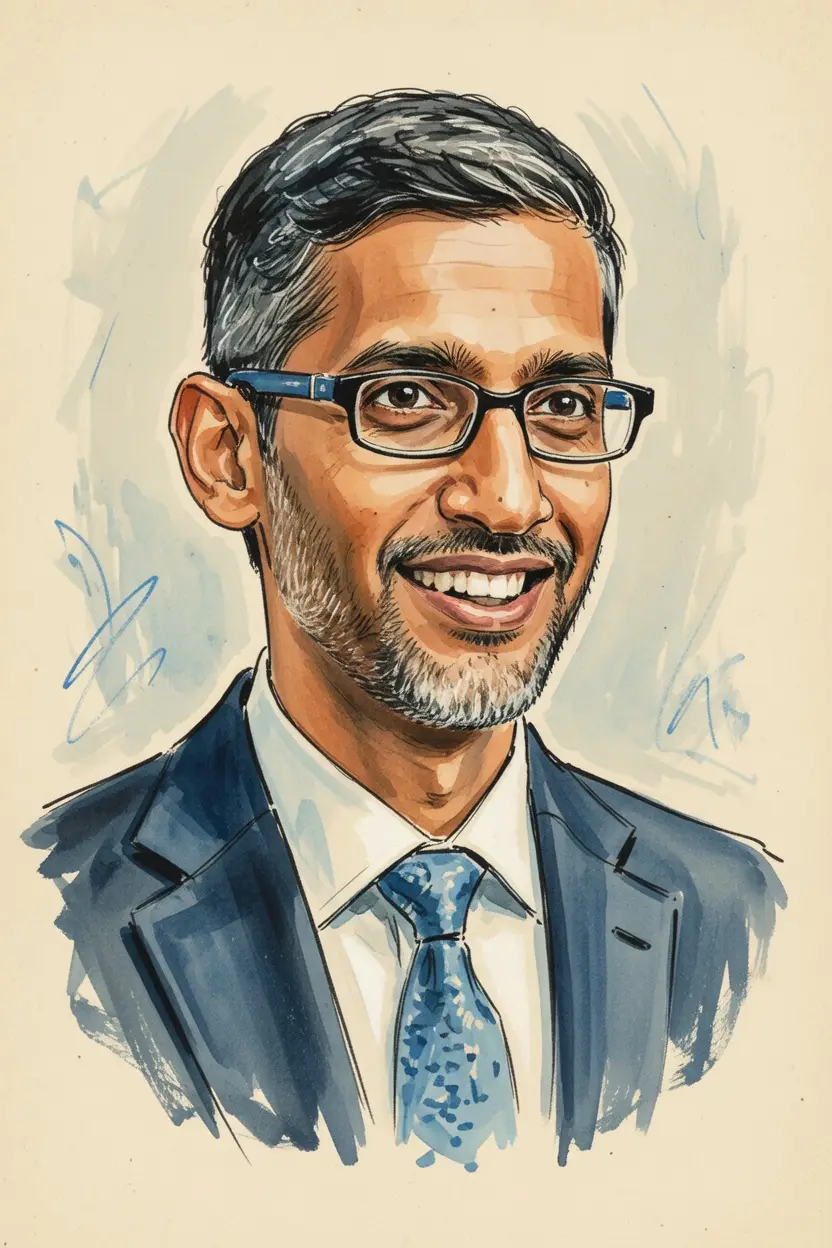
Sundar Pichai on Future of Artificial Intelligence
TL;DR
Sundar Pichai views AI as a profound, transformative technology that requires responsible deployment alongside deep technical breakthroughs.
Key Points
He predicted a potential slowdown in the visible pace of AI development around 2025 as the 'low-hanging fruit' of LLMs is exhausted, requiring deeper technical shifts.
Pichai estimates the probability of AI leading to catastrophic human outcomes (P(doom)) to be around 10%, but remains hopeful that humanity will adapt.
He sees diffusion models as a promising, faster complement to traditional transformer architecture, reflecting an ethos to experiment widely and unify architectures where sensible.
Summary
Sundar Pichai views the future of Artificial Intelligence as an era of profound transformation, comparable to the advent of electricity, where the technology will impact every product and industry, fundamentally reshaping productivity and creativity. His core position is marked by a blend of excitement for its capabilities—such as AI collaborators for professionals like radiologists—and caution regarding its development speed and societal integration. He strongly advocates for a measured approach, emphasizing that current LLMs are reaching a point of convergence, and future progress will hinge on deeper technical breakthroughs beyond simply scaling compute power. He has also warned about the potential for an "AI bubble" fueled by overheated optimism, urging users to avoid blind trust in AI outputs due to inherent risks like hallucination.
He has noted a mismatch between the rapid pace of AI evolution and the slower adaptation rate of societal institutions, stressing the need for broad societal engagement on regulation and ethics, which he views as an alignment problem involving not just engineers but also social scientists and philosophers. Pichai detailed Google's R&D efforts, including experimenting with diffusion models for speed and efficiency, and developing 'world models' grounded in physics for better reasoning, alongside work on recursive self-improving agents. He also expressed a commitment to user control, floating the idea of portable AI memory for autonomous agents, underscoring that the future of AI must be built boldly yet responsibly.
Frequently Asked Questions
Sundar Pichai maintains a cautiously optimistic view, seeing AI as a profoundly positive, general-purpose technology set to reshape productivity and creativity like electricity did. However, he balances this optimism with strong warnings about potential industry bubbles, the risk of societal misalignment, and the necessity for responsible, staged deployment.
He believes the next major phase of AI innovation will not be driven by simply throwing more compute power at problems, but will require fundamental technical breakthroughs. This includes advancements in algorithmic efficiency, improved system reasoning, and pushing paradigms like diffusion models and recursive self-improving systems. He notes that his company is actively exploring these areas.
The CEO views the challenge of ensuring AI aligns with human values as a deep societal question, not one a single company should decide. He has pointed to the problem of 'hallucination' in current models and the potential for massive societal harm from scaled disinformation like deepfakes, advocating for early regulatory discussion.
Sources5
Google CEO Sundar Pichai on AI's Future, 2025 Slowdown, and Challenges
Google CEO Sundar Pichai warns of growing AI bubble, says no company is safe
Interview Recap: Sundar Pichai on AI's Inflection Point — Diffusion Models, Self-Improving Agents, and the Future of Work
Google's Developers on the Future of AI on 60 Minutes Transcript | Rev
Inside the Mind of Sundar Pichai: Leadership, AI, and the Future of Human Creativity
* This is not an exhaustive list of sources.