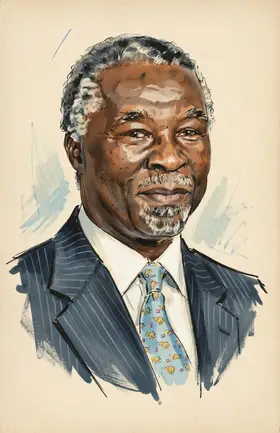
Thabo Mbeki on Education
TL;DR
Thabo Mbeki advocates for an education system focused on critical thinking, practical solutions, and countering monolithic thought patterns across society.
Key Points
He stated that the purpose of education is to train thinkers who question everything, rather than those who merely accumulate facts.
Mbeki has called upon the intelligentsia in higher education to develop tangible, practical solutions for South Africa's crises, moving past the National Development Plan's vision stage.
He expressed that his own ability to make a serious contribution to building South Africa stemmed from completing school and university, highlighting the importance of education for leadership.
Summary
Thabo Mbeki has strongly positioned education, particularly at the university level, as a crucial tool for national and continental development, demanding that it move beyond theory to produce actionable solutions for systemic crises. Speaking at events such as the Eastern Cape Higher Education Sector National Dialogue Launch, he stressed that the intelligentsia must step up with practical action plans to address issues like economic woes, crime, and corruption, rather than merely offering visions or 'wish lists'. He asserted that the role of education is to nurture innovative, ethical, and qualified individuals capable of leading and contributing to societal betterment, a view reinforced by the establishment of institutions like the Thabo Mbeki African School of Public and International Affairs.
His vision for intellectual leadership requires a fundamental shift in pedagogy, urging educational institutions to foster thinkers who question established norms, rather than conforming to a single dominant ideology. He noted a personal regret that a lack of education could have prevented him from contributing meaningfully to South Africa, underscoring the necessity of quality schooling and university completion for effective public service. Furthermore, Mbeki has urged African governments to prioritize history education, connecting current challenges to the past, and encouraging the intelligentsia to advise diverse constituencies on translating national visions into tangible steps.
Frequently Asked Questions
Thabo Mbeki's core philosophy emphasizes that education must cultivate critical and creative thinking, training individuals to question everything and be instruments of change. He believes this is vital for producing the intellectual leadership required to solve Africa's challenges.
He urged African universities, including the Thabo Mbeki African School of Public and International Affairs, to serve as philosophical thought centres for society. For him, they must generate usable knowledge and advise various constituencies on practical action plans, not just accumulate facts.
Sources5
We need action, not wish lists - News
Training the next generation of thinkers who question everything
Thabo Mbeki Quotes About School | A-Z Quotes
* This is not an exhaustive list of sources.