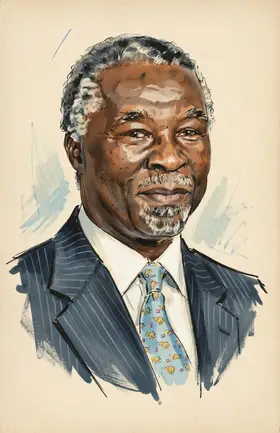
Thabo Mbeki on Land Reform
TL;DR
Thabo Mbeki opposed expropriation without compensation, advocating for legal, constitutional redistribution that upholds property rights and broad economic goals.
Key Points
He argued in 2021 that expropriation without compensation goes against the ANC's Freedom Charter and represents an 'Africanist' position adopted by breakaway groups.
During his presidency, he reassured the business community that land redistribution would occur within the law, respecting property rights and the principle of compensation (circa 2000).
He maintained that land reform must be a tactical matter, not a strategic one, and should be aligned with creating a thriving, inclusive economy outside of agriculture.
Summary
Thabo Mbeki's position on land reform has been primarily defined by his opposition to the policy of expropriation without compensation (EWC), which he argued contradicted the foundational principles of the African National Congress's (ANC) Freedom Charter. He asserted that land redistribution must adhere strictly to the Constitution, maintaining respect for property rights and the principle of compensation for acquired land. Mbeki viewed EWC as a tactic that risked damaging investor confidence and isolating capital, which he felt the country could not afford while pursuing broader economic development. He insisted that land reform must be integrated with the larger national democratic revolution's goal of building a non-racial, prosperous society, rather than being treated as a purely racial or punitive measure against one group.
His perspective emphasizes that the ultimate goal of land reform is to address historical injustice and land hunger by ensuring land is shared among those who work it, consistent with the Freedom Charter's original intent. He suggested that the controversy over EWC was misplaced, as the Constitution already allowed for expropriation in the public interest, provided compensation was just and equitable. Mbeki has called for a comprehensive program of action that integrates land reform with economic policy, urban development, and food security, rather than focusing narrowly on punitive land acquisition measures.
Frequently Asked Questions
Thabo Mbeki strongly advocated for land reform to redress historical injustices but consistently opposed expropriation of land without compensation. His position required that any land acquisition by the state must respect constitutional provisions, including the principle of compensation.
No, Thabo Mbeki firmly opposed EWC, arguing that it represented a radical departure from the ANC's historic policy as enshrined in the Freedom Charter. He viewed such a move as a disincentive to investment and potentially damaging to the national democratic revolution's broader economic goals.
Thabo Mbeki viewed the Constitution as the guiding framework for land reform, confirming that it allows for expropriation when necessary, provided it is done justly and equitably with compensation. He insisted the process must not undermine the rule of law.
Sources6
RECAP: Mbeki tells ANC that land without compensation goes against the party's Freedom Charter
Viewpoint ♦ What Then About Land Expropriation Without Compensation? The National Democratic Revolution Must Resolve the Intimately Inter-Connected Land and National Questions!
Thabo Mbeki's strategy — Helen Suzman Foundation
Mbeki slams ANC over SA land redistribution plan
Mbeki says S. Africa to speed up land reform
Mbeki slams ANC over land redistribution plan
* This is not an exhaustive list of sources.