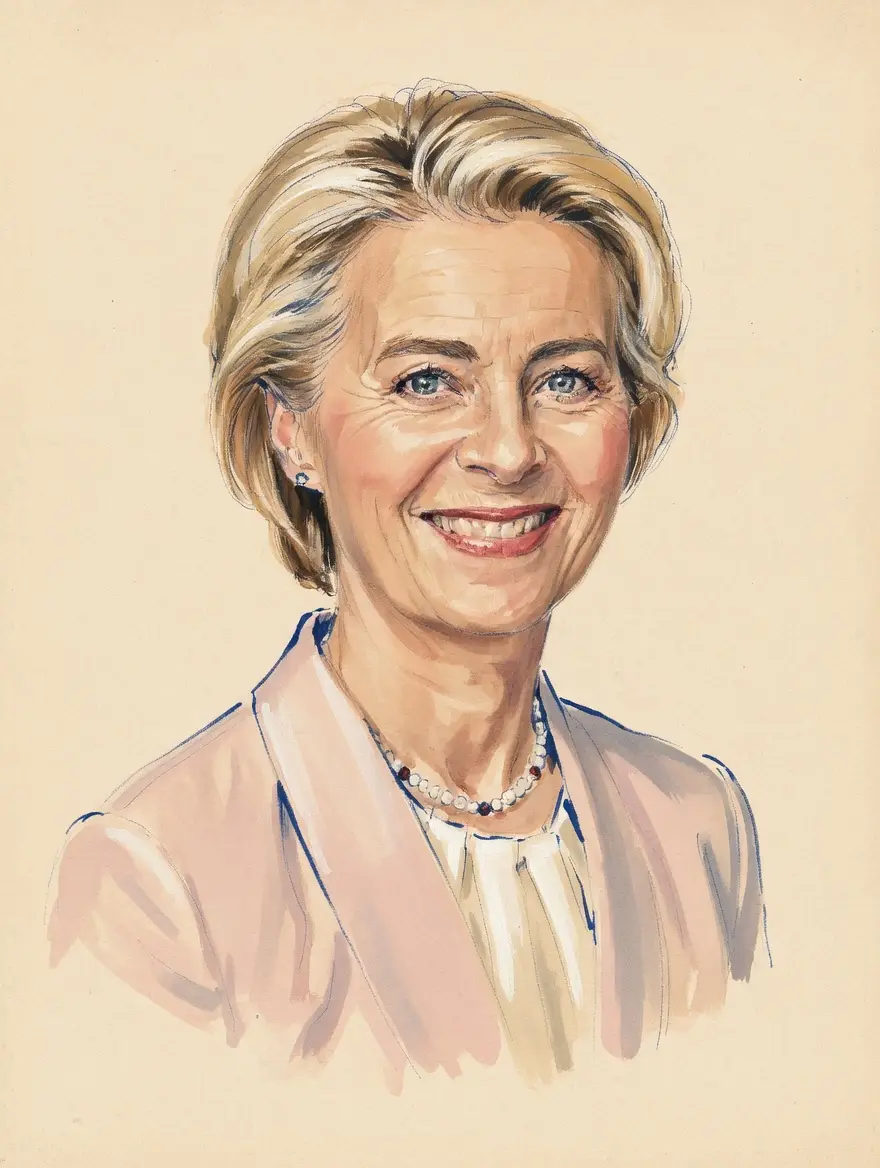
Ursula von der Leyen on China
TL;DR
Ursula von der Leyen views China as a partner, competitor, and systemic rival that requires the EU to strategically de-risk its economic dependencies.
Key Points
The President committed to a new plan aimed at helping the EU break its dependence on China for critical materials by 2030.
She met with Foreign Minister Wang Yi on July 2, 2025, ahead of the EU-China Summit to discuss deepening cooperation and global challenges.
The European Commission president stated that the EU must enhance its economic security by implementing de-risking measures concerning China.
Summary
Ursula von der Leyen’s core position on China is defined by a tripartite framing: partner on global issues, economic competitor, and systemic rival. This stance mandates a strategic shift for the European Union toward 'de-risking' rather than full 'de-coupling' from the Chinese economy. The President emphasizes that while China is of vital importance for addressing worldwide challenges like climate change, bilateral ties are being tested by growing global uncertainties and tensions. This approach seeks to maintain mutually beneficial economic and trade cooperation while mitigating vulnerabilities, particularly concerning critical raw materials.
This strategy was highlighted in communications leading up to the EU-China Summit, serving as an opportunity to celebrate the 50th anniversary of diplomatic relations and chart future cooperation. She looks forward to in-depth communication on shared concerns, stressing the need for both entities to act as forces for global stability and certainty. The position underscores a commitment to upholding multilateralism, free trade, and international rules, while the President also reiterates the EU's adherence to the one-China policy.
Frequently Asked Questions
Ursula von der Leyen's main policy framework positions China simultaneously as a partner, competitor, and systemic rival. She advocates for a strategy of 'de-risking' the European Union's economic relationship with China rather than pursuing complete 'de-coupling'.
Her approach has seen an evolution towards a more security-conscious stance, emphasizing the need to address dependencies. The introduction of the de-risking concept signals a refinement of the EU's engagement strategy with Beijing.
She affirmed the commitment to mutually beneficial economic and trade cooperation with China. However, she stressed that this cooperation must be balanced with the need to manage risks and enhance the EU's economic security.
Sources4
President of the European Commission Ursula von der Leyen Meets with Wang Yi_Permanent Mission of the People's Republic of China to the UN
President Ursula von der Leyen on the future of EU-China relations
EU trying to end China rare earth dependence - von der Leyen
EU meet in Belgian castle to tackle economic rivalry with US, China
* This is not an exhaustive list of sources.